


Airship market through 2040: companies, size, and forecast

The modern airship market: companies, projects, investment, and development outlook through 2040
Modern airships are returning to the industry agenda thanks to new materials, control systems, and growing interest in logistics for hard-to-reach areas. Yet there is still a considerable gap between technological feasibility and a mass market: some companies are already testing aircraft, others are preparing for certification and production, while many commercial use cases still need to prove their economic viability.
This article examines the structure of the global airship market, its key developers, differences between technologies, published forecasts, and development scenarios through 2040. It also looks separately at the niche targeted by the New Generation Airships project, whose funding is organized by SOLARGROUP.
What the global airship market includes
Industry reports typically use the term airship market to cover a range of categories: advertising and sightseeing aircraft, airborne surveillance platforms, passenger concepts, cargo airships, hybrid systems, and specialized solutions. This is an important caveat: revenue from the existing market for advertising or surveillance aircraft is not equivalent to the future market size of heavy cargo aviation.
Segments differ by design—non-rigid, semi-rigid, and rigid aircraft; by purpose—advertising, monitoring, tourism, transportation, and research; and by customer—commercial operators, government organizations, and research institutions. Each segment has its own certification, cost, and ground infrastructure requirements.
How modern airships work and how the technologies differ
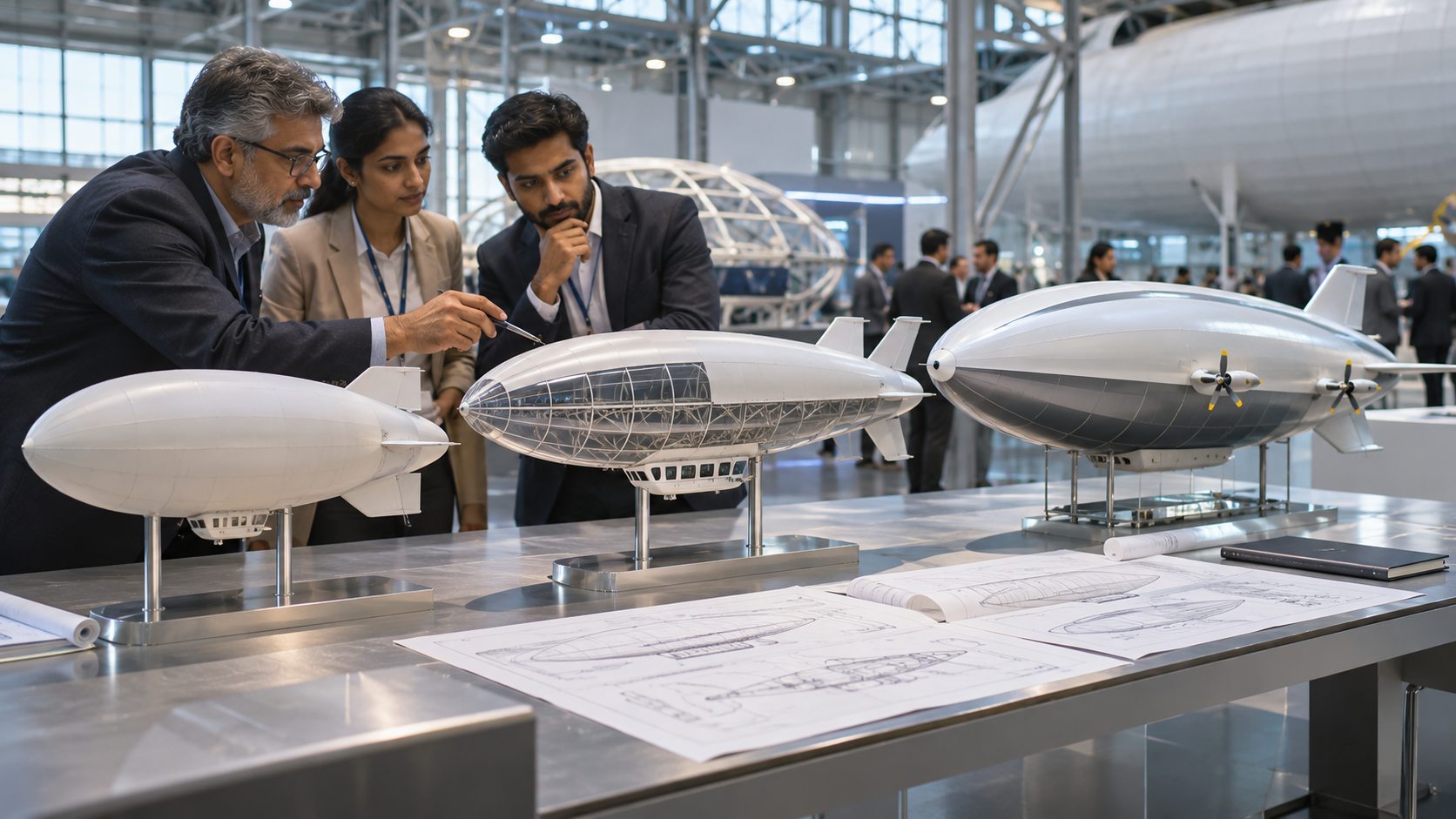
| Type | Design principle | Potential applications |
| Non-rigid | The envelope’s shape is maintained by internal pressure | Advertising, surveillance, and small aircraft |
| Semi-rigid | The envelope is combined with load-bearing elements | Various transportation and specialized concepts |
| Rigid | An external structural frame maintains the shape | Large aircraft and prospective cargo platforms |
| Hybrid | Aerostatic and aerodynamic lift in varying proportions | Transportation concepts and specialized missions |
In a conventional airship, most lift is generated by a lighter-than-air gas, usually helium. Engines provide propulsion and maneuverability. This creates the potential for lower energy use to remain aloft, but it does not eliminate fuel consumption to overcome drag, operate systems, and conduct ground operations.
Hybrid aircraft also use aerodynamic lift. Their advantages and limitations cannot be summed up in a single statement: speed, payload, weather conditions, balancing, loading, infrastructure, and life-cycle cost all matter. It is incorrect to claim that any airship is cheaper than any airplane or helicopter without a specific route and supporting calculations.
Airship market size: why analyst estimates vary so widely
The attached industry reports show a wide range of estimates. Straits Research values the 2025 market at $714.32 million and forecasts $1.52 billion by 2034, with a CAGR of 8.75%. Dataintelo gives figures of $1.8 billion for 2025 and $3.6 billion by 2034, with a CAGR of 8.1%. Market Research Future uses a substantially narrower base: $0.09 billion in 2025 and $0.43 billion by 2035, with a CAGR of 16.59%. Custom Market Insights cites $451 million in 2023 and about $769 million by 2032, with a CAGR of 6.1%.
| Source | Baseline estimate | Forecast | CAGR reported by the source |
| Straits Research | $714.32 million (2025) | $1,519.69 million (2034) | 8.75% (2026–2034) |
| Dataintelo | $1.8 billion (2025) | $3.6 billion (2034) | 8.1% |
| Market Research Future | $0.09 billion (2025) | $0.43 billion (2035) | 16.59% |
| Custom Market Insights | $451 million (2023) | ≈$769 million (2032) | 6.1% |
These figures should not be averaged or treated as mutually corroborating. The differences may reflect segment boundaries, the set of companies included, revenue estimation methods, and base years; the full methodologies of the paid reports are not disclosed in the attached materials. The appropriate conclusion is therefore that analysts expect growth within their respective models, but there is no single generally accepted market size.
The headline “forecast through 2040” does not mean there is a single verified dollar figure specifically for 2040. In the available attached reports, the forecast horizons end between 2032 and 2035. For the period through 2040, it is more reasonable to discuss scenarios, development conditions, and key uncertainties than to invent an exact market capitalization figure.
Companies developing modern airships
Hybrid Air Vehicles — Airlander
The British company Hybrid Air Vehicles is developing the Airlander hybrid platform. The project is known for combining aerostatic and aerodynamic lift and targeting passenger and specialized applications. Investors should distinguish among flight demonstrations by earlier models, plans for a new production version, and actual deliveries of production aircraft: these represent different stages of maturity.
LTA Research — Pathfinder
The US company LTA Research is developing large airships in the Pathfinder family. Its work represents a technological approach to large aircraft using modern materials and control systems. Flight testing does not in itself prove the economics of large-scale cargo transportation; further progress depends on testing, approvals, and the operating model selected.
Flying Whales — LCA60T
The French company Flying Whales is working on the LCA60T, a large cargo airship concept designed to transport heavy loads, including in areas with challenging road infrastructure. Its stated technical specifications and commercial plans must be distinguished from what has actually been achieved in certification and regular operations.
Goodyear and specialized aircraft in operation
Goodyear aircraft demonstrate that airships already occupy real niches, such as surveillance and media events. However, the economics of an advertising airship do not automatically prove the viability of a heavy cargo airship. These are adjacent but distinct markets.
AERONOVA — the New Generation Airships project
The company is developing a range of airships in different classes, from experimental and light aircraft to prospective cargo models. Each is at its own stage of development, testing, or design.
Project comparison: what has been achieved and what remains planned
| Company / project | Focus | What investors should consider |
| Hybrid Air Vehicles / Airlander | Hybrid passenger and specialized aircraft | Current version, certification, and production readiness |
| LTA Research / Pathfinder | Large airships | Testing program and transition to operational use |
| Flying Whales / LCA60T | Heavy cargo transportation | Prototype stage, approvals, and infrastructure |
| Goodyear | Media and surveillance flights | An established niche, not equivalent to heavy logistics |
| AERONOVA / NOVA | A range of experimental and prospective aircraft | Testing, NOVA-2 assembly, certification, and future economics |
The table describes technological directions, not a ranking of companies by investment appeal. The level of public detail on testing, funding, and orders varies; comparing stated payload capacities and future revenue without a common methodology would be inappropriate.
Where airships could generate real demand
Remote cargo transportation and oversized equipment
One of the most widely discussed use cases is delivering industrial equipment to places where building a road or airfield is expensive and ground access is limited. This could apply to energy, mining, and large construction projects. Competitiveness, however, depends on the weather, flight frequency, loading, payload, insurance, and the total cost of the logistics operation.
Monitoring, research, and communications
Airships could serve as long-endurance airborne platforms for surveillance, mapping, environmental research, and communications. Key considerations for these tasks include time on station, stability, power supply for the payload, and operating approvals.
Tourism and passenger routes
Passenger concepts focus not on maximum speed but on the flight experience and selected regional routes. Safety, certification, comfort, flight frequency, and customers’ willingness and ability to pay are critical to the business case.
Rescue and humanitarian missions
In certain scenarios, an airborne platform could be useful where roads are damaged or inaccessible. But this does not mean an airship can fly safely in all adverse weather: wind limits, landing sites, and the organization of ground operations remain fundamental considerations.
What is holding back market development
The first constraint is certification and safety: new designs must demonstrate compliance with applicable requirements. The second is infrastructure: even with less dependence on runways, hangars, parking areas, maintenance, helium handling, and ground operations are still required. The third is weather, particularly wind and the organization of loading operations.
The fourth barrier is economics. Customers care not only about the cost per tonne-kilometer but also the total delivery cost, transit time, schedule reliability, and risk of cargo damage. The fifth constraint is funding: engineering programs may require several successive rounds before they begin generating revenue from series production.
Airship market outlook through 2040: three scenarios
| Scenario | What needs to happen | Potential outcome by 2040 |
| Conservative | Lengthy testing, costly operations, and limited infrastructure | The market remains predominantly niche |
| Qualitative baseline | Several platforms are certified, and repeatable commercial routes emerge | Gradual expansion of cargo and specialized niches |
| Accelerated | Successful certification, proven economics, production scaling, and demand | Broader adoption in selected regions and industries |
These are analytical scenarios, not a quantitative forecast or a promise that any of them will materialize. The key indicator of the industry’s development is not the growing number of concept renderings or press releases, but the number of certified aircraft, hours of safe operation, commercial orders, and repeatable deliveries.
How the New Generation Airships project is progressing
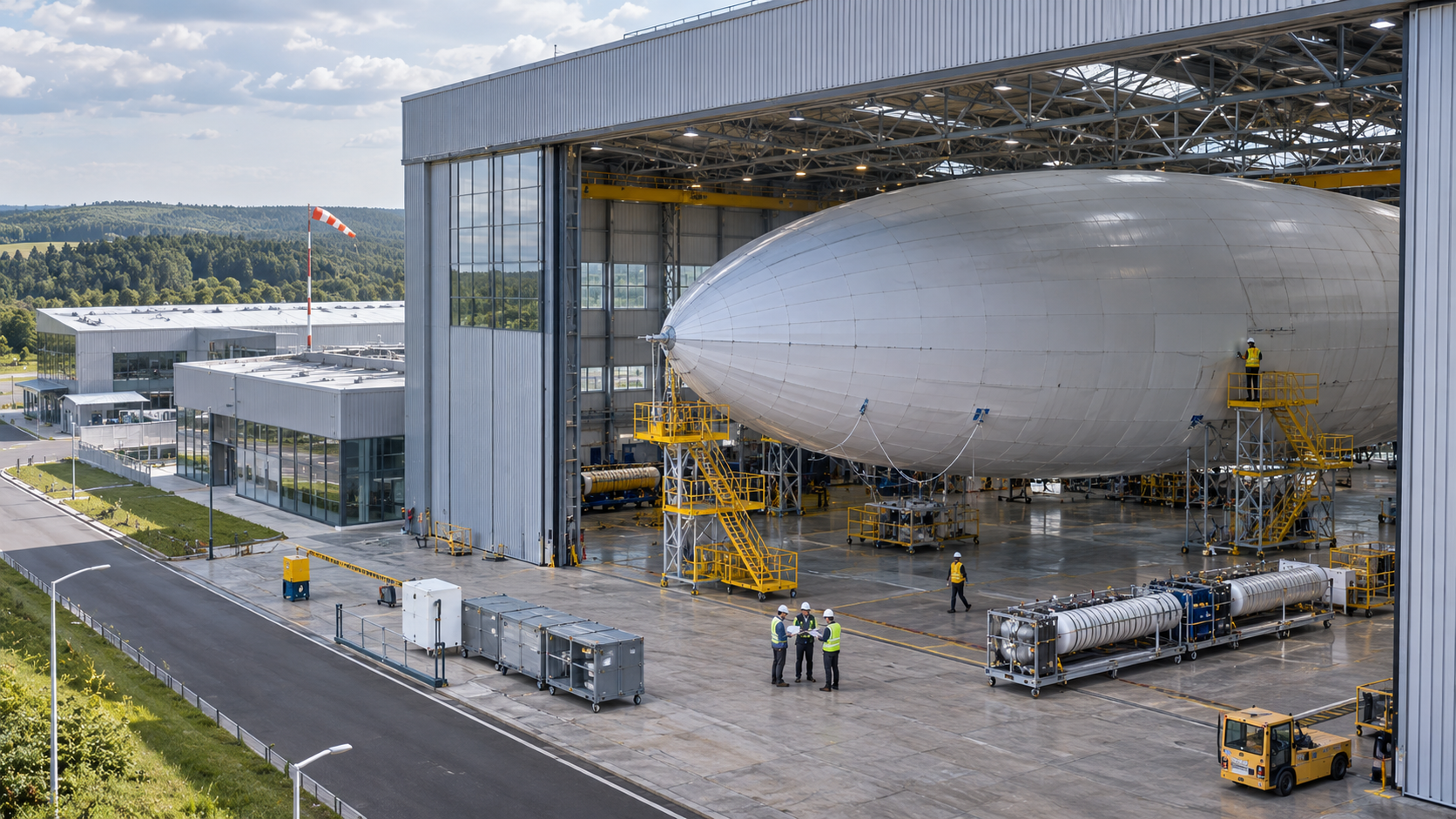
On August 19, 2026, production of the NOVA-2 envelope, with a volume of about 2,000 m³, was completed at AERONOVA’s own facility. Production of the tail assembly, gondola, metal structures, and onboard systems continued in parallel. The site in Kirzhach was being prepared for assembly and testing. In a digest published in September, the company reported that the envelope had been delivered to Kirzhach and had undergone an initial cycle of strength checks; this work should not be confused with completion of the entire airship’s assembly.
In a digest published on September 3, 2026, SOLARGROUP reported that the project had moved to the fourth funding stage on September 2. Unlike earlier advance announcements, this report confirms that the transition had taken place. Current participation terms and technical news should be checked against the project’s official materials.
Engineering achievements have been complemented by initial commercial results. In October 2026, AERONOVA reported receiving the first payment from a customer on October 8 and beginning to commercialize its developments; the company had previously begun fulfilling an order for a tethered aerostat system. However, certification of new models, production scaling, and the development of a sustainable market still lie ahead. The first order does not mean that the entire airship range has already entered serial operation.
How investors should assess the market and a specific project
Do not start with a projected valuation. First determine what cargo and route the aircraft is intended for, who the potential customer is, what prototype exists, what testing has shown, what it costs to operate, and what approvals are still required. Then assess the budget needed to reach the next stage, the funding structure, and investor rights.
For collective investments, it is especially important to understand exactly what is being purchased now: shares, investment units, or other contractual rights; what terms govern a potential exchange; whether the asset can be transferred; and what fees, dilution risks, and exit options exist. Terms from other projects cannot automatically be applied to AERONOVA.
Is it worth investing in airships?
The market has technological foundations and real developers, but uncertainty remains high. Potential industry growth does not equal returns for an individual investor. Even if the technology develops successfully, a company may face additional costs, competition, delays, or a lack of liquidity for holders of investment rights.
If long-term engineering projects appeal to you and you are prepared to assess the high risks involved, review the New Generation Airships roadmap in your SOLARGROUP account. There you can learn about the project, follow its news, and review the available investment documentation. Any decision should be made only after checking the current terms and the laws applicable in your country.
Frequently asked questions
How large is the global airship market?
In the attached analytical reports, estimates for 2025 range from approximately $90 million to $1.8 billion. This wide range means that the market definition and research methodology should be clarified before any figure is cited.
What is the airship market forecast through 2040?
The materials reviewed contain no single, reliably substantiated numerical forecast specifically for 2040. Different agencies forecast growth through 2032–2035; beyond that, it is more reasonable to evaluate scenarios based on certification and actual commercial deliveries.
Which companies are developing modern airships?
Notable participants include Hybrid Air Vehicles, LTA Research, Flying Whales, Goodyear, and AERONOVA. They are working with different designs, target markets, and stages of readiness.
Can you make money by investing in airships?
The potential financial outcome depends on the specific instrument and contract terms. An increase in value or payments is not guaranteed; there is a risk of losing all invested capital and facing prolonged illiquidity.