


The Economics of Cargo Airships: Where Air Logistics Could Be More Cost-Effective Than Traditional Transport

The Economics of Cargo Airships: Where Air Logistics Could Be More Cost-Effective Than Traditional Transport
In a nutshell: a cargo airship has an advantage where the main expense is not transportation itself but the infrastructure around it: roads, bridges, airfields, seasonal winter roads, and route preparation for oversized cargo.
Introduction
Interest in cargo airships has returned in recent years, and not because of nostalgia for the age of Zeppelins. The reasons are entirely practical: the rising cost of deliveries to remote areas, the need to transport ever-larger equipment for the energy and industrial sectors, requirements to reduce emissions, and new technologies—including envelope materials, digital control systems, electric and hybrid propulsion systems, and unmanned operation.
To understand where an airship can be more cost-effective than traditional transport, we need to examine its economics: what makes up its transportation costs, how they differ from those of trucks, airplanes, and helicopters, and which applications turn these differences into an advantage.
Why Cost per Kilometer Alone Is the Wrong Comparison
The most common mistake when comparing modes of transport is to look only at the rate per tonne-kilometer. For ordinary cargo transported over a good road, that is enough. But for heavy equipment, a remote site, or an area without roads, the actual cost of delivery comprises many items:
- transportation itself;
- preparing roads, bridges, and sites for the cargo;
- permits and approvals for oversized cargo transportation;
- loading, transshipment, and unloading;
- downtime, including seasonal downtime;
- specialized equipment;
- last-mile delivery.
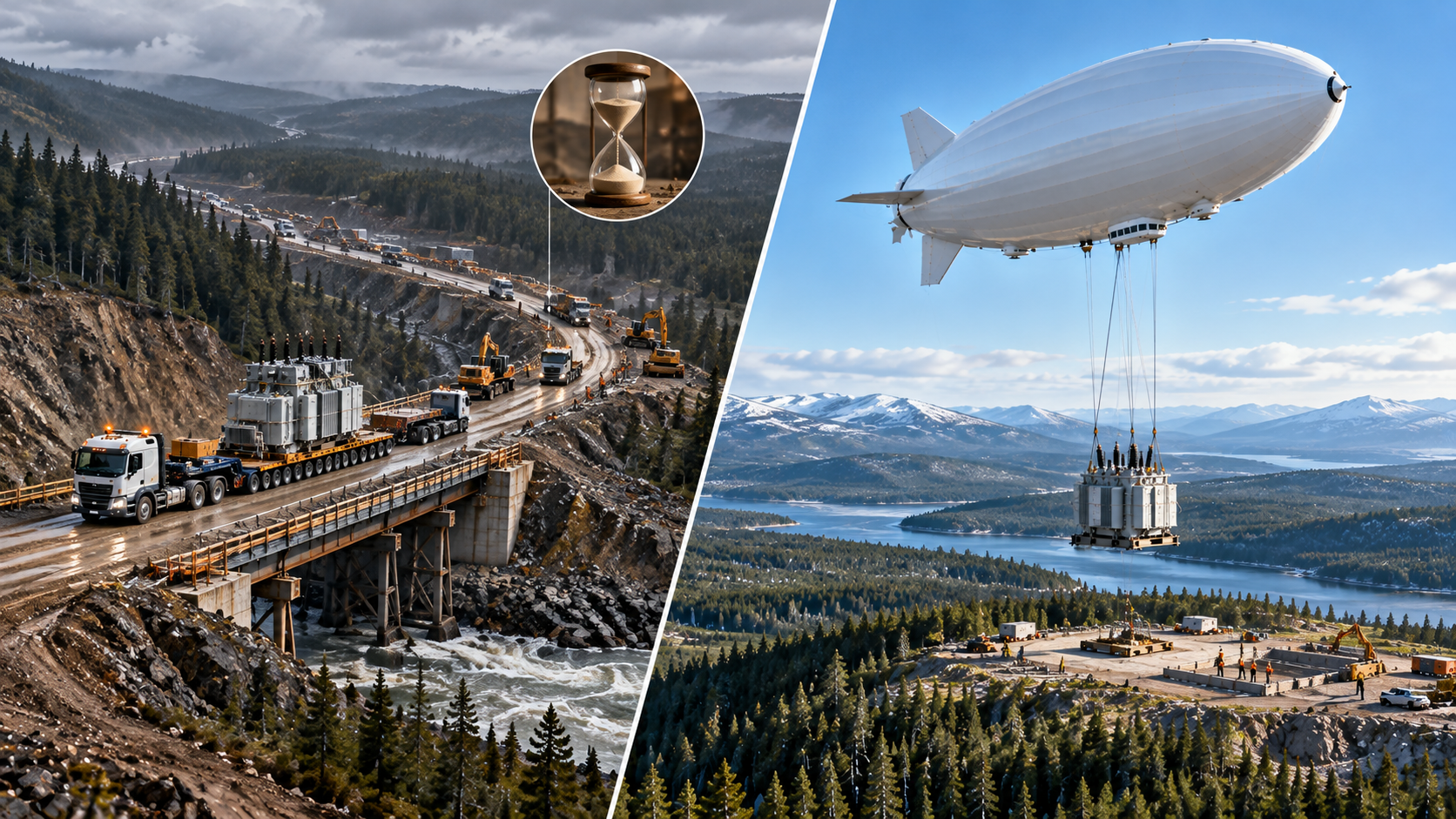
Air delivery should be compared with the sum of all these expenses. An airship may carry cargo more slowly than an airplane and cost more per kilometer than a truck, yet still cost less overall because it does not require a road, runway, or transshipment.
What Drives Airship Economics
1. Gas-generated lift. Much of an airship’s lift comes from a lighter-than-air gas—nonflammable helium. Unlike an airplane or helicopter, the craft does not need to expend energy simply to stay aloft. As a result, an airship’s energy consumption per tonne of cargo is fundamentally lower than a helicopter’s. Researchers estimate that carbon dioxide emissions could be reduced by up to 75% compared with airplanes.
2. Minimal infrastructure requirements. An airship does not need a runway or airport. A prepared site and mooring mast are sufficient for operations, and cargo can be lowered on cables directly to its destination.
3. Payload and dimensions. The envelope’s volume makes it possible to transport oversized cargo that will not fit inside an airplane’s cargo hold and exceeds a helicopter’s capabilities.
4. Speed. An airship is slower than an airplane but faster than overland delivery across roadless terrain, and it is not constrained by the seasonal availability of winter roads or shipping.
5. Operating expenses. The main items are the propulsion system and energy, helium, envelope maintenance, the crew or remote-control system, and ground handling. Unmanned operation and electric propulsion systems reduce some of these expenses.
6. Flight utilization. As with any mode of transport, the economics improve when the craft operates for many hours per year and does not return empty.
What Research Shows
One detailed study of cargo airship economics was conducted at the University of Manitoba in Canada. A 2013 master’s thesis, “Assessing the Competitiveness of a Cargo Airship for Supplying Isolated Regions of Northern Canada,” compared the cost of supplying remote communities in three regions: the eastern shore of Lake Winnipeg, northwestern Ontario, and central Nunavut.
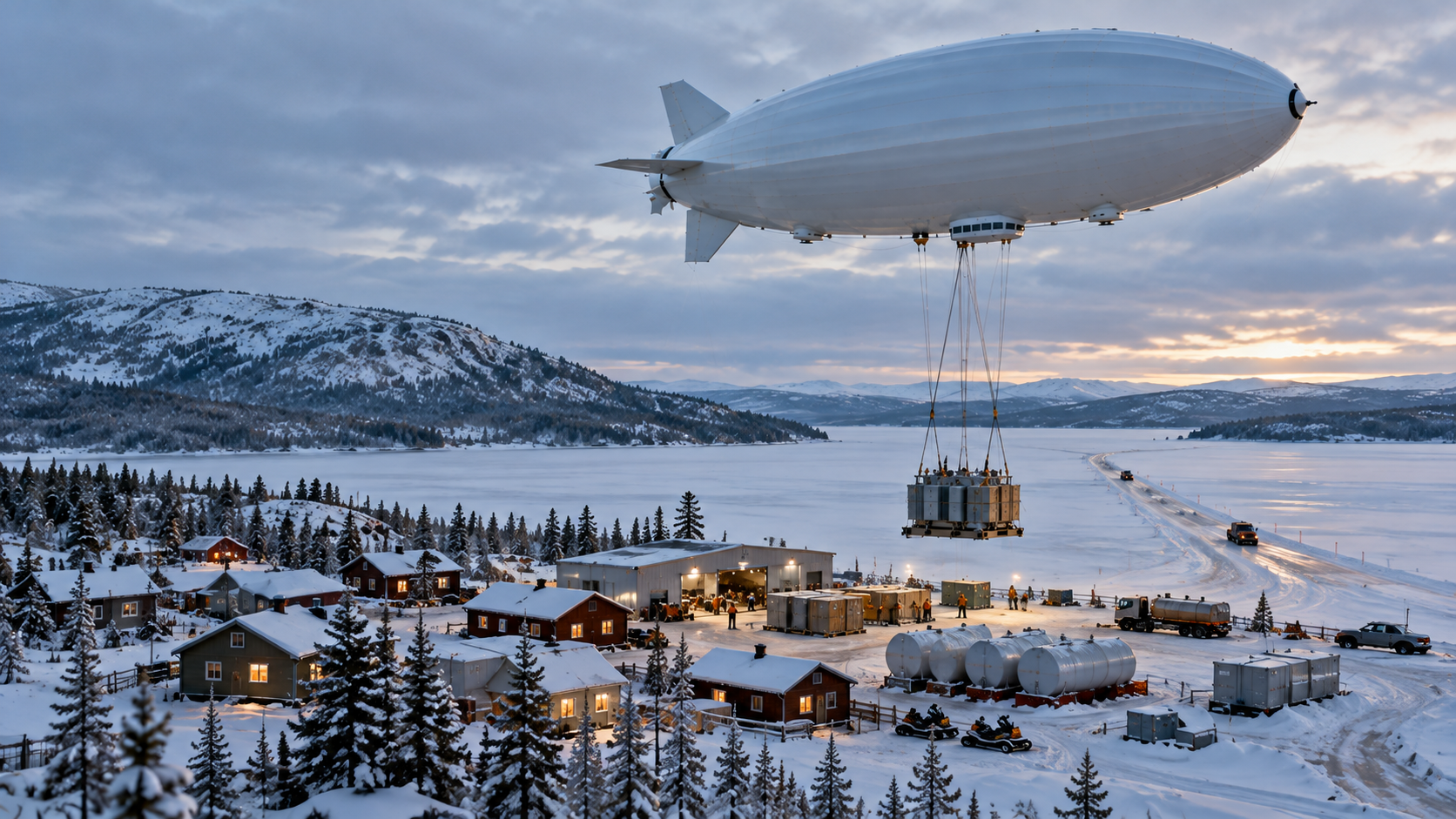
The study’s baseline data clearly illustrate why northern logistics are so expensive:
- transportation over winter roads cost 60–70% more than average freight rates;
- air delivery in one of the regions was 625% more expensive than delivery over a winter road;
- winter roads operate for only a few weeks a year, and the length of their season depends on the weather.
The model considered an airship with a payload of 50 tonnes, a cruising speed of 125 km/h, and annual utilization of 7,200 hours. Even under the conservative assumption that the craft would return empty, the calculation showed annual transportation cost savings ranging from 12.5% to 38.3%, depending on the scenario. The results were similar across all three regions.
This example demonstrates the main pattern: the more expensive and complex the existing logistics, the greater the economic benefit of air delivery that does not depend on infrastructure.
Where Airships Could Be More Cost-Effective Than Traditional Transport
1. Supplying Remote and Northern Regions
Communities, resource sites, and remote work camps that receive cargo via seasonal winter roads, by water during a short shipping season, or by airplane. An airship can operate year-round and deliver cargo directly to the destination without transshipment.
2. Heavy and Oversized Equipment
Transformers, generators, drilling rigs, process modules, and metal structures. Overland transportation of such cargo requires specialized trailers, permits, route surveys, bridge reinforcement, and sometimes even the construction of a temporary road. An airship can eliminate a substantial portion of these expenses.
3. Energy and Construction
Wind turbine blades, power transmission tower components, and construction modules for sites in hard-to-reach areas. Cargo dimensions and delivery precision at the site are important for these applications.
4. Mining and Oil and Gas
Resource deposits are often located far from the road network. Delivering equipment and supplying the sites is an ongoing, expensive task in which infrastructure savings are particularly significant.
5. Emergencies and Humanitarian Missions
Areas cut off from ground transport after floods, earthquakes, and other natural disasters. An airship can deliver a large volume of aid and remain over the area for extended periods.
6. Monitoring and Specialized Applications
Monitoring pipelines, power lines, forests, and extensive areas. The ability to remain aloft for long periods with low energy consumption makes an airship a practical platform for these applications.
How Airships Complement Other Modes of Transport
| Parameter | Truck | Rail | Helicopter | Cargo Airplane | Cargo Airship |
|---|---|---|---|---|---|
| Requires a road or track | Yes | Yes | No | No | No |
| Requires a runway or airport | No | No | No | Yes | No |
| Oversized cargo | Limited by the route | Limited by the loading gauge | Limited by payload capacity | Limited by the cargo hold | Key advantage |
| Point-to-point delivery | By road | No | Yes | No | Yes |
| Speed | Moderate | Moderate | High | Very high | Moderate |
| Energy consumption per tonne of cargo | Low | Very low | Very high | High | Low |
| Infrastructure costs for a remote site | High | Very high | Low | High | Low |
Each mode of transport excels in its own niche. Rail remains the most cost-effective way to move bulk cargo over an existing network, trucks are best for regular deliveries on good roads, and airplanes are the right choice when speed matters most. Airships occupy a niche between them: large and heavy cargo, remote destinations, and locations without infrastructure.
Who Is Developing Cargo Airships
Several companies in different countries are developing cargo airships:
- Flying Whales (France) is developing the LCA60T cargo airship, with a payload capacity of 60 tonnes, to deliver heavy cargo to remote areas;
- Hybrid Air Vehicles (United Kingdom) has begun type certification of the Airlander 10 hybrid aircraft;
- LTA Research (United States) is building the Pathfinder series of airships;
- AERONOVA (Russia) is implementing the “New Generation Airships” project.
Several independent programs in different countries are pursuing the same idea: lighter-than-air cargo craft have their own niche in the transportation system.
The “New Generation Airships” Project
“New Generation Airships” is a project to develop, manufacture, and commercially operate innovative airships, implemented by AERONOVA. The project is being developed with the help of SOLARGROUP, an international IT platform that facilitates investment.
Progress to date:
- experimental craft have been assembled and tested: the NOVA-01 unmanned platform and the hybrid AEROLЁT-01; following testing, AEROLЁT-01 was moved to the airfield in Kirzhach, where it is being restored and its design refined;
- the company launched in-house envelope production; on August 19, 2026, production of the envelope for the full-size NOVA-2 was completed: its volume is 2,000 m³, its length is 43.2 m, and its maximum diameter is 9.6 m;
- on September 1, 2026, the envelope was filled with air for the first time, and the first cycle of strength testing was successfully completed; over the following days, the envelope underwent elevated-pressure testing, and the ballonet was checked for leaks;
- AERONOVA has moved on to final assembly of NOVA-2.
The aircraft lineup is structured to increase payload capacity in stages:
| Aircraft | Purpose | Status |
|---|---|---|
| NOVA-01 | Unmanned experimental platform for validating key technical solutions | Testing |
| AEROLЁT-01 | Hybrid experimental aircraft | Restoration and design refinement following testing |
| NOVA-2E | Unmanned electric cargo version, 2,000 m³, stated payload capacity of 0.5 t | Being assembled; it will be the first to take flight |
| NOVA-2 (crewed) | 1 pilot and 5 passengers, two ULPower helicopter engines | Engines purchased and delivered |
| NOVA-8 | Next production model | Detailed design is underway; production of parts and the load-bearing framework will begin no earlier than 2027 |
| NOVA-35 | Larger model | On the roadmap after serial production of NOVA-8 |
Several project decisions directly support the economics of future operations:
- in-house envelope production—the envelope is a key component and one of the most expensive parts of an airship;
- an unmanned cargo version—reducing crew costs;
- the electric propulsion system of NOVA-2E;
- step-by-step scaling from experimental aircraft to production models.
On September 2, 2026, the “New Generation Airships” project advanced to funding stage 4.
Frequently Asked Questions
Why can a cargo airship be more cost-effective than a helicopter? A helicopter uses a great deal of energy to stay aloft and has limited payload capacity. An airship remains aloft using lighter-than-air gas, so its energy consumption per tonne of cargo is significantly lower.
Can an airship compete with a truck? On a good road with ordinary cargo, a truck remains the optimal choice. An airship has the advantage where there is no road or where preparing a route for heavy cargo costs more than the transportation itself.
Where is the economic benefit of airships greatest? In remote and northern supply operations, heavy and oversized equipment delivery, the energy and mining sectors, and emergency response. The University of Manitoba study on northern Canada found potential annual transportation cost savings ranging from 12.5% to 38.3%.
Why are modern airships safe? Modern airships use nonflammable helium instead of hydrogen, new high-strength envelope materials, and digital control systems.
What stage has the “New Generation Airships” project reached? The NOVA-01 and AEROLЁT-01 experimental aircraft have been assembled and tested, the envelope for the full-size NOVA-2 has been manufactured and tested, and final assembly of NOVA-2 is underway. The unmanned electric cargo version, NOVA-2E, will be the first to take flight.
Conclusion
The economics of a cargo airship are based not on competing with trucks or airplanes on cost per kilometer, but on the ability to deliver large cargo where traditional transport requires expensive infrastructure. The more remote the site and the heavier the cargo, the greater this effect—something also supported by calculations for Canada’s northern regions.
AERONOVA’s “New Generation Airships” project is developing this field step by step: experimental aircraft have been assembled and tested, in-house envelope production has been launched, final assembly of NOVA-2 is underway, and the NOVA-2E cargo version and the NOVA-8 and NOVA-35 production models lie ahead.
This material is for informational purposes only and does not constitute personalized investment advice. Crowdinvesting involves risk: the financial outcome depends on project execution, production development, sales, and subsequent corporate transformation.
Learn more about the “New Generation Airships” project and the current terms of participation in your account:SOLARGROUP — Registration and Project Selection.