


From Prototype to Mass Production: How a Deep Tech Project Becomes a Major Business

From Prototype to Mass Production: How a Deep Tech Project Becomes a Major Business
The key point in one sentence: A Deep Tech project becomes a major business not when the invention is made, but when it completes the “prototype — testing — production — mass production — sales” chain. An investor who joins early in this chain gains access to growth that is unavailable in a mature market.
Introduction
Most technologies that seem commonplace today have a long history behind them. The lithium-ion battery, the electric motor for an electric vehicle, satellite communications—each existed as laboratory prototypes for years before becoming a mass-market product. The greatest value in this story comes not from the idea itself, but from the ability to bring it to mass production.
This is precisely why technology commercialization is a discipline in its own right. A working prototype answers the question, “Is it technically possible?” Mass production answers different questions: Can the product be manufactured consistently, at an acceptable cost, and for real customers?
This article explains:
- the stages a Deep Tech project passes through on its way to market;
- what happens to risk and the company's value at each stage;
- why the transition from prototype to mass production is the most important part of the journey;
- what this journey looks like in practice, using two engineering projects being developed on the SOLARGROUP platform as examples.
What Is Deep Tech, and How Does Its Path to Market Differ from That of a Conventional Startup?
Deep Tech refers to companies built around a scientific or engineering breakthrough: a new operating principle for a motor, a new material, or a new type of aircraft. These companies do not simply package existing solutions into a new service; they create the underlying technology itself.
This is the main difference from an IT startup. A mobile app can be launched within a few months and improved every week. A Deep Tech product must be designed, fabricated as a physical product, tested, certified, and only then put into production.
|
Parameter
|
IT startup
|
Deep Tech project
|
|
First product
|
A basic version within months
|
A prototype in years
|
|
Main expenses
|
Developers and marketing
|
Equipment, materials, testing, manufacturing
|
|
Indicator of progress
|
User growth
|
Testing, certification, mass production
|
|
Protection from competitors
|
Speed and brand
|
Patents, know-how, manufacturing base
|
|
Potential
|
Rapid growth in an existing market
|
Creating a new market
|
The long journey is both a challenge and an advantage. The more engineering and manufacturing stages a company has already completed, the harder it is for a competitor to catch up.
Stages of the Journey: From Idea to Major Business
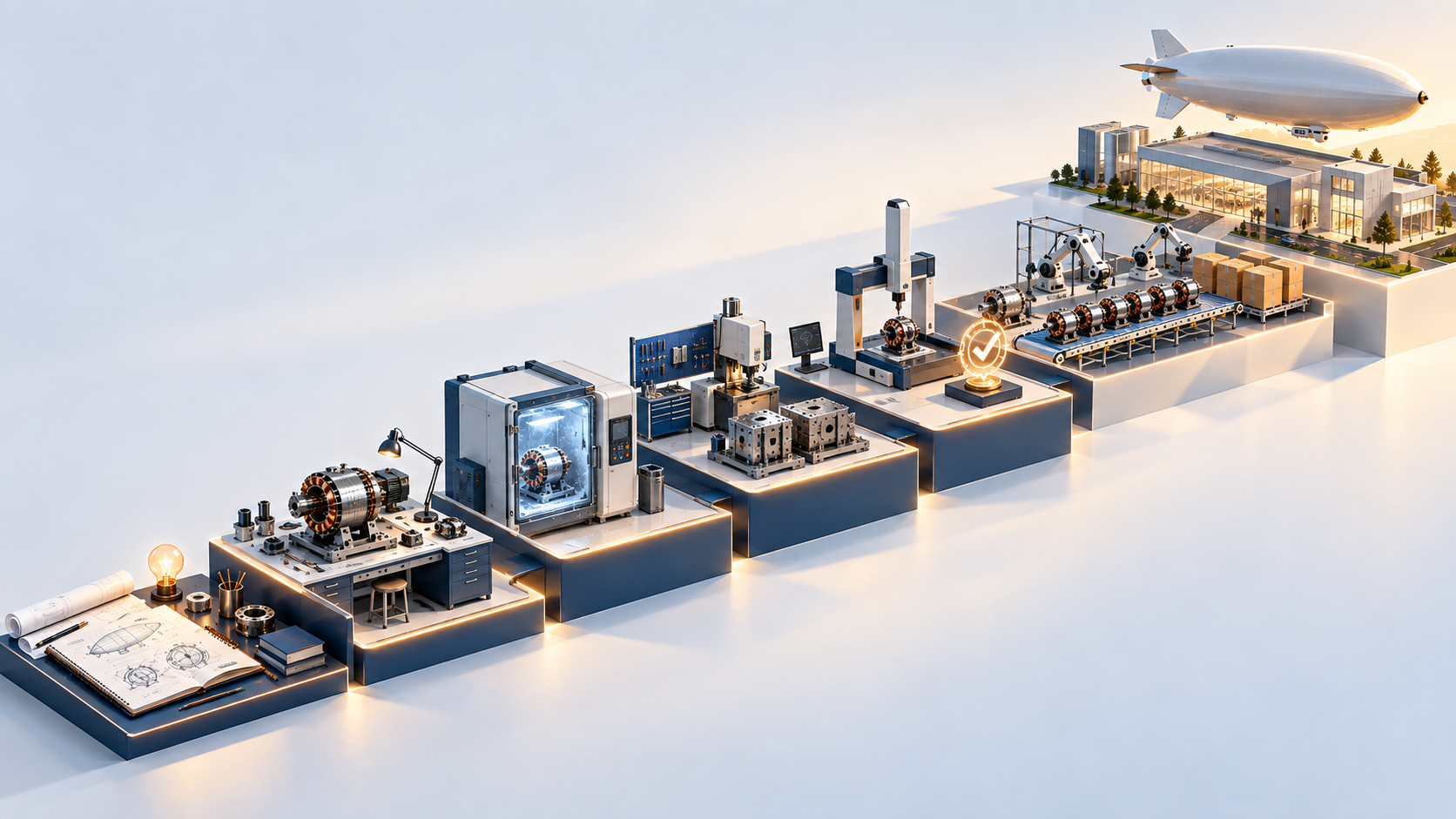
The journey of a Deep Tech project can be divided into seven stages. The nine-level TRL (Technology Readiness Level) scale developed by NASA is used to assess technology maturity. The table maps the stages to this scale.
|
Stage
|
What happens
|
TRL level
|
What the project gains
|
|
1. Idea and calculations
|
Scientific principle, modeling, patents
|
1–3
|
A protected idea
|
|
2. Prototype
|
The first working model in a laboratory
|
4–5
|
Proof that the technology works
|
|
3. Testing
|
Testing under near-real-world conditions
|
6–7
|
Data for refinement and scaling
|
|
4. Production preparation
|
Tooling, production processes, facility
|
7–8
|
The ability to manufacture the product consistently
|
|
5. Certification
|
Confirmation of compliance with requirements
|
8
|
The right to sell the product
|
|
6. Mass production
|
Batches of products for customers
|
9
|
Revenue and market feedback
|
|
7. Scaling
|
Higher volumes, new models, new markets
|
9
|
Major business
|
Each stage removes some uncertainty, so the company's value also increases. An investor who entered at the prototype stage receives a stake in the project at a price that reflects the early risks. As the project moves up this ladder, those risks decrease.
Why the Transition from Prototype to Mass Production Is the Key Threshold
A prototype and a mass-produced item are two different products, even when they look alike. Engineers assemble a prototype by hand, selecting parts and adjusting assemblies. Every unit of a mass-produced product must be identical from batch to batch.
To take this step, a company needs to:
- develop tooling and a production process for every component;
- master key operations in-house or build a reliable supplier chain;
- establish quality control and finished-product testing;
- complete certification;
- bring production costs down to a level at which the product is economically viable for the buyer.
This stretch is known as the “valley of death”: roughly between TRL 4 and TRL 7, the technology has been proven in the laboratory but is not yet generating revenue. Research grants run out by this point, while traditional capital waits for mass-production results. Projects that make it through this stretch gain a substantial advantage: they have a manufacturing base, a certified product, and their first customers.
How a Deep Tech Company Enters the Market: The “Beachhead” Strategy
Many advanced technologies can be applied across several industries at once. A new type of electric motor can be used in tools, machine tools, electric vehicles, and household appliances. An aircraft can transport cargo or passengers, or perform specialized tasks.
Experienced teams do not try to enter every market at once. They choose a first beachhead market—narrow enough to focus resources, but large enough to generate initial sales and feedback. The company can then expand its product line and move into adjacent niches.
A good first product for a Deep Tech company usually:
- leverages the technology's key advantage;
- has a clear sales channel;
- requires a manageable certification process;
- makes it possible to obtain customer feedback quickly.
What Changes for Investors at Each Stage
|
Project stage
|
What is important to assess
|
Potential for investors
|
|
Idea and prototype
|
Team, patents, physical principle
|
Highest: entry at the earliest price
|
|
Testing
|
Test results, scaling plan
|
High: the project is reducing technical risks
|
|
Production preparation
|
Facility, equipment, tooling
|
High: a manufacturing base is taking shape
|
|
Mass production
|
Certification, deliveries, customers
|
A clear, tangible result
|
|
Scaling
|
Sales growth, new models and markets
|
Growth alongside the business
|
For a private investor, the main takeaway is simple: a project should be assessed by which stages it has already completed and substantiated, and by how realistic its plan for the next steps is.
Example 1. Duyunov's Motors: From Crowdfunding to Mass Production
Duyunov's Motors is an international project aimed at developing the Slavyanka combined-winding technology and bringing it to the global market. Under the project, Sovelmash develops and manufactures energy-efficient electric motors for industry, electric transport, agriculture, and household appliances. This was the first project whose funding was organized by the SOLARGROUP platform.
The project's journey clearly shows how the “prototype — mass production” chain works:
- On June 1, 2017, the project's first online presentation was held, announcing the launch of crowdfunding.
- By the end of the first stage, 9,786 participants had registered through the user account portal, 1,715 investors had purchased investment packages, and the total amount raised had exceeded 50 million rubles.
- The project's central objective was to create Sovelmash's design and engineering technology bureau (D&E)—an engineering enterprise that would develop electric motors based on Slavyanka technology and prepare them for production.
- On July 22, 2026, a permit to commission the D&E was issued. The facility has been completed and is fulfilling orders.
- The first mass-produced product is an Angle grinder designed for 230 mm discs, available in three models rated at 2100, 2300, and 2500 W. All models are certified. They are built around an induction drive based on Slavyanka technology, with no permanent magnets or brushes, and an in-house controller.
- In September 2026, additional batches of Angle grinders were shipped to customers, while a batch of Angle grinders and electric motors was delivered to the plant of Sovelmash's partner in China, ASPP Weihai, for testing and discussions on the framework for further cooperation.
This is a classic example of the beachhead strategy. Power tools are a mass market with a clear sales channel. In this market, the technology proves itself in real-world operation, while the production team refines its mass-production processes. At the same time, Sovelmash is developing new products based on its drives.
The project is now in its final, 20th funding stage and is preparing to complete it. Sovelmash is preparing to convert into a joint-stock company: the deadline for submitting the asset valuation was set for October 20, 2026. After the conversion, the investment units are planned to be exchanged for shares in proportion to the number of units held by each investor. Under the original model, investors were to receive 50% of the shares issued; the final conversion ratio will be determined before the exchange.
The key takeaway from this example is that SOLARGROUP's collective funding, launched in 2017, made it possible to implement a multiyear engineering and industrial project in stages: build an enterprise, equip it, and begin mass-producing products.
Example 2. New Generation Airships: From Prototypes to a Full-Scale Aircraft
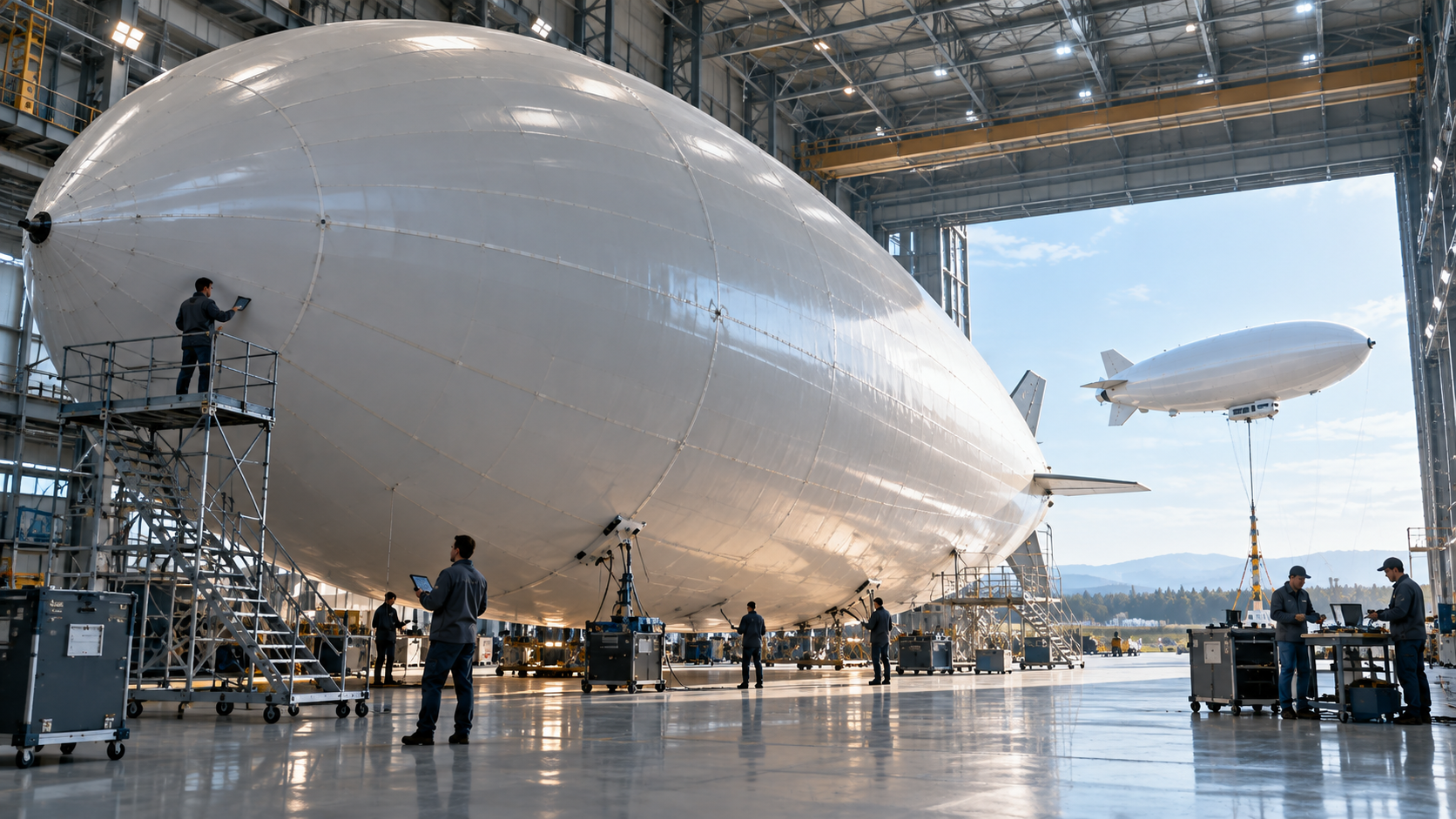
New Generation Airships is a project to develop, manufacture, and commercially operate innovative airships, implemented by AERONOVA. It is at an earlier point on the same journey, making it a clear illustration of how a project advances from one stage to the next.
Test aircraft. The NOVA-01 unmanned airship and hybrid AEROLЁT-01 have been assembled and are undergoing flight tests. On August 1–2, 2026, AERONOVA participated in the VIVA AVIA! festival in Novosibirsk, where NOVA-01 led the aeronautics program.
In-house manufacturing. The company launched in-house production of airship envelopes. On August 19, 2026, the envelope for the full-scale NOVA-2 airship was completed there:
- volume — 2,000 m³;
- length — 43.2 m;
- maximum diameter — 9.6 m.
Testing. The envelope was transported to the assembly site in Kirzhach. On September 1, 2026, it was inflated with air for the first time and successfully completed the initial strength-testing cycle. The envelope then underwent an elevated-pressure test, while the ballonet passed a leak-tightness test with no unacceptable leaks or deviations.
Assembly. NOVA-2 has been fully designed. The tail assembly, gondola, metal structures, onboard electronics, battery systems, and other components are being manufactured in parallel. By September 22, 2026, AERONOVA had moved to final assembly: after the necessary tests, all systems will be integrated into a single NOVA-2E unmanned cargo aircraft.
Aircraft lineup. The unmanned electric cargo version, NOVA-2E, is planned to be the first to take flight. Two helicopter engines made by the Belgian company ULPower have already been purchased and delivered for the crewed passenger version of NOVA-2. NOVA-8 has been named as the next production model and is at the detailed design stage.
|
Aircraft
|
Role in project development
|
Current status
|
|
NOVA-01
|
Unmanned test aircraft
|
Assembled; undergoing flight tests
|
|
AEROLЁT-01
|
Hybrid test aircraft
|
Assembled; undergoing flight tests
|
|
NOVA-2 / NOVA-2E
|
First full-scale aircraft
|
Envelope manufactured and tested; final assembly under way
|
|
NOVA-8
|
Next production model
|
Detailed design
|
On September 1, 2026, the New Generation Airships project moved to its 4th funding stage. By then, NOVA-01 was already undergoing tests, and the full-scale NOVA-2 envelope had been manufactured at the company's own production facility.
For investors, this is a stage at which the project has already demonstrated working aircraft and in-house manufacturing, while the next steps—assembling NOVA-2, testing it, and moving to production models—account for the main growth potential.
How Two Projects Demonstrate the Same Journey
|
Stage of the journey
|
Duyunov's Motors / Sovelmash
|
New Generation Airships / AERONOVA
|
|
Prototypes and testing
|
Completed
|
Test aircraft are flying
|
|
In-house manufacturing
|
D&E commissioned
|
Envelope production launched
|
|
Certified product
|
Three Angle grinder models
|
Ahead
|
|
Mass-production deliveries
|
Under way since 2026
|
Ahead; the next production model is NOVA-8
|
|
Funding stage
|
20th, final
|
4th
|
The first project shows that a collective funding model can take an engineering project from crowdfunding to an operating enterprise. The second is following the same path in a new industry—aeronautics—and is at the stage where early entry offers the greatest growth potential.
What Investors Should Look for When Choosing a Deep Tech Project
- Completed stages. Are there real aircraft or products, rather than only renderings?
- In-house manufacturing. Does the company make key components itself?
- Testing. What results have already been obtained, and how were they published?
- Market-entry strategy. Which product will come first, and why?
- Team. Does it have experience not only in development, but also in manufacturing?
- Participation model. What does an investor receive today, and what corporate steps are planned next?
- Momentum. How quickly does the project move from one stage to the next?
The article “How to Evaluate a Deep Tech Project Before Investing” explains the evaluation criteria in detail.
Frequently Asked Questions
What does technology commercialization mean?
It is the journey from a scientific or engineering development to a product that is mass-produced and sold to customers. It includes prototyping, testing, production preparation, certification, and market entry.
Why is the transition from prototype to mass production so difficult?
A prototype proves that the technology works. Mass production requires tooling, established processes, quality control, certification, and acceptable production costs. This is a major stage of work in its own right.
At what stage is it most advantageous to invest in Deep Tech?
At early stages, a stake costs less and the growth potential is higher. At later stages, there are more substantiated results. Many investors choose projects that have already demonstrated working prototypes but have not yet reached mass production.
What examples of moving from prototype to mass production can be found among SOLARGROUP projects?
As part of Duyunov's Motors, Sovelmash built the D&E, launched mass production, and supplies certified Angle grinders to customers. As part of New Generation Airships, AERONOVA is testing NOVA-01 and AEROLЁT-01, has launched envelope production, and is assembling the full-scale NOVA-2.
What funding stage is the New Generation Airships project currently at?
On September 1, 2026, the project moved to funding stage 4. Current participation terms are available in the SOLARGROUP account.
Conclusion
A Deep Tech project becomes a major business one step at a time: from a protected idea to a prototype, from testing to production, and from its first production run to scaling. Each completed stage reduces uncertainty and increases the company's value, while the most important threshold is the move from a prototype to mass production.
Projects on the SOLARGROUP platform demonstrate this journey in practice. Duyunov's Motors has already progressed from crowdfunding to an operating enterprise and mass-production deliveries. New Generation Airships is following the same trajectory: its aircraft are flying, envelope production has been launched, and the full-scale NOVA-2 is being assembled. For investors, this is an opportunity to participate in the technology's growth at a stage when most of the journey to mass production still lies ahead.
This material is for informational purposes only and does not constitute personalized investment advice. Crowdinvesting involves risk: financial outcomes depend on project execution, the development of production and sales, and the subsequent corporate conversion.
You can learn more about the New Generation Airships project and current participation terms in your account: SOLARGROUP — registration and project selection .