


Helium in airship economics: costs and supply

Helium in airship economics: filling costs, leakage, and supplier dependence
Helium provides an airship with aerostatic lift. For an investor, it is both a technical resource and a cost item: the gas must be purchased, delivered, retained on board, and replenished when necessary.
To assess its impact on the business, knowing the price per cubic meter is not enough. It is also necessary to understand the volume required for the initial fill, actual operating losses, and the supply arrangements for a future fleet.
Why helium must be accounted for separately from fuel
In a helium airship, the lifting gas and the energy source serve different purposes. Helium provides buoyancy, while the propulsion system provides movement and control in the operating modes allowed by the design.
The full filling volume therefore cannot automatically be treated as an expense for every flight. However, it would also be wrong to assume that gas costs disappear after the initial fill.
The cost structure has two components:
- the initial filling of the aircraft;
- subsequent losses, technical operations, and replenishment.
USGS materials treat helium as a distinct industrial resource with its own production, use, and supply structure.

What determines the cost of the Initial fill
The basic calculation is straightforward:
Gas cost = required volume × price per comparable unit of volume.
However, commercial offers must be compared on a like-for-like basis. Important factors include the temperature and pressure to which the volume is referenced, the required gas purity, the delivery method, and additional services.
The final budget may include:
- the helium itself;
- delivery and transshipment;
- rental of transport containers or equipment;
- operation of the filling system;
- quality control;
- process losses;
- mandatory local charges.
The producer's price and the cost of gas at the operating site can therefore differ significantly. A project considering operations in several countries requires a separate assessment of each supply chain.
How helium losses occur
Losses may be associated with the gas permeability of materials, the condition of joints and valves, damage, repair work, and operations required by the design.
It is inappropriate to apply a universal leakage rate to all airships. The rate depends on the design, materials, age of the aircraft, and operating conditions.
Data useful to an investor should be accompanied by details on:
- the period over which losses were measured;
- the conditions in which the aircraft was kept;
- whether maintenance and repairs were included;
- whether changes in temperature and pressure were taken into account;
- whether the test result can be applied to a production model.
A single figure without a measurement methodology can create a false impression of precision.
How losses affect costs: an illustrative example
Suppose a model calculation assumes 10 000 standard cubic meters of helium at an illustrative gas price of 10 monetary units per cubic meter.
The initial volume would then cost 100 000 monetary units, excluding delivery and maintenance.
| Annual replenishment as a percentage of the initial volume | Replenishment volume | Illustrative gas cost |
| 1% | 100 m³ | 1 000 |
| 3% | 300 m³ | 3 000 |
| 5% | 500 m³ | 5 000 |
This is an illustration of calculation sensitivity, not AERONOVA specifications, market prices, or industry leakage rates. It shows which inputs are needed for the assessment.
For a commercial model, gas costs are then allocated across the actual number of flights or transport volume. If the aircraft is idle, the same annual amount is spread across fewer completed orders.
Can helium be recovered and reused?
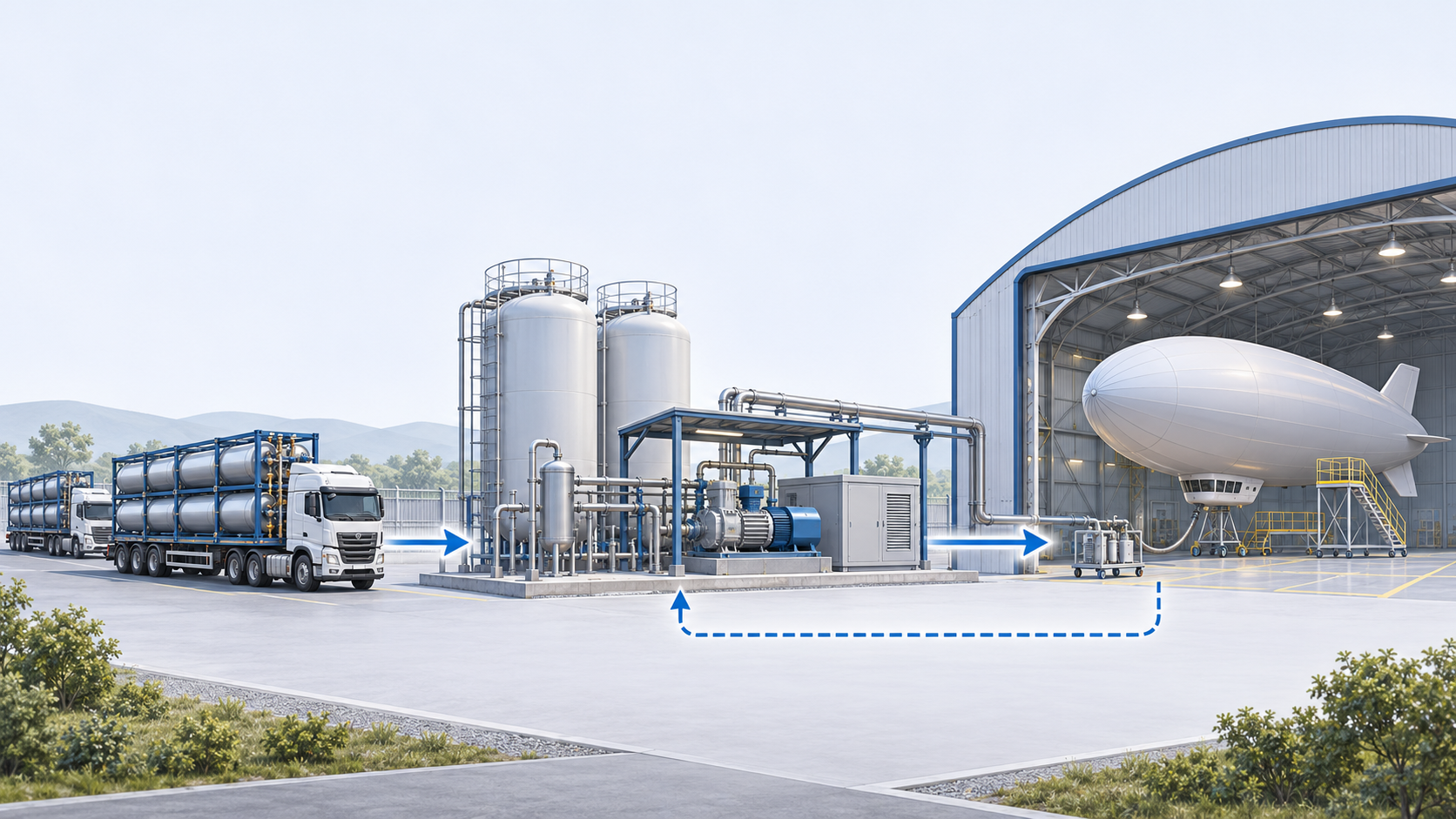
During certain operations, some of the gas can be retained for later use if the design and ground system provide for this. For example, LTA Research reports that it is working to retain and reuse helium. LTA Research FAQ.
This does not mean, however, that all lost gas can be recovered. Helium that has already dispersed into the atmosphere is not available for routine collection near the aircraft.
A gas recovery system also requires equipment, space, energy, and maintenance. Its economic benefit must be calculated from the value of the losses it prevents, taking the system's own costs into account.
Why the supplier matters just as much as the price
Even an acceptable price does not solve the problem if the gas does not arrive on time. A shortage of the required volume can delay filling, maintenance, or the commissioning of a new aircraft.
The supply assessment should therefore include:
| Question | Business significance |
| How many suppliers are available? | Ability to replace the primary supplier |
| What are the delivery lead times? | Planning maintenance and aircraft commissioning |
| Is there a minimum order quantity? | Working capital and storage requirements |
| How does the contract price change? | Cost predictability |
| What terms apply during supply disruptions? | Risk of operational delays |
| How much helium can be stored at the base? | Operational resilience between deliveries |
For India, Vietnam, and African countries, it is important to assess the specific operating location. The availability of helium on the global market does not in itself confirm that the required volume can be delivered to a remote base on time.
How to assess fleet scaling
Filling a single aircraft for the first time and supplying a growing fleet present different challenges.
As the number of airships increases, the filling of new aircraft, replenishment of those in operation, reserves, and transport infrastructure must all be considered at the same time. The ability to purchase gas for a prototype does not prove that the supply chain is ready for serial production.
At the same time, an expensive resource does not automatically make the business unviable. What matters is its share of the total transportation cost and the route's ability to generate sufficient revenue.
What to examine in the new generation airships project
When examining AERONOVA, it is useful to request any available information on the required gas volume, loss measurement results, maintenance, and planned supply arrangements.
Parameters from another manufacturer cannot be applied to the project's aircraft: differences in design and intended use can change the calculation.
For a potential investor, this analysis helps shift the question from the broad “Is helium expensive?” to the more precise “How are helium costs and supply accounted for in the commercial model?”
You can explore the project materials and participation terms through SOLARGROUP. Any decision should be made after comparing the technical data, business plan, and investment risks.
Frequently asked questions
Does an airship need to be filled completely before every flight?
The full volume of gas should not be treated as a cost for each flight. Actual replenishment is determined by the losses and operating procedures of the specific model.
Is there a single figure for the cost of filling an airship?
Without the required volume, gas specifications, and delivery terms, such a figure provides little useful information.
Does reusing helium guarantee that there will be no replenishment costs?
No. The ability to retain some of the gas does not eliminate all losses and requires its own infrastructure.