

Investing in the Transport of the Future: Which Technologies Could Create New Markets Over the Next 10–20 Years

Investing in the Transport of the Future: Which Technologies Could Create New Markets Over the Next 10–20 Years
In a nutshell: The transport of the future is taking shape at the intersection of electrification, autonomy, new materials, and new types of aircraft. The greatest opportunities for investors arise when a technology does not merely improve an existing market but creates a new one.
Introduction
Transport is one of the foundations of the global economy. It connects cities and countries and supports industry and trade. According to industry research, transport contributes 5–10% of GDP in many countries and accounts for up to 8% of employment.
At the same time, the industry is undergoing its most profound transformation in decades. Several forces are driving it at once:
- requirements to reduce emissions;
- urban growth and increasing pressure on roads;
- advances in artificial intelligence and autonomous control systems;
- new materials, batteries, and motors;
- the need for deliveries to places without developed infrastructure.
In its Sustainable and Smart Mobility Strategy, the European Union set a target of reducing transport emissions by 90% by 2050 and established interim milestones: at least 30 million zero-emission cars on European roads and large-scale deployment of automated mobility by 2030, and market-ready large zero-emission aircraft by 2035. Similar programs exist in China, the United States, Russia, and other countries.
For investors, this means one thing: the transport industry will be reshaped over the next 10–20 years, and some of the technologies now undergoing testing will become the foundation of new markets. Let us examine which areas appear most promising and how investors can participate in them.
Why the Transport of the Future Is a Long-Term Investment Theme
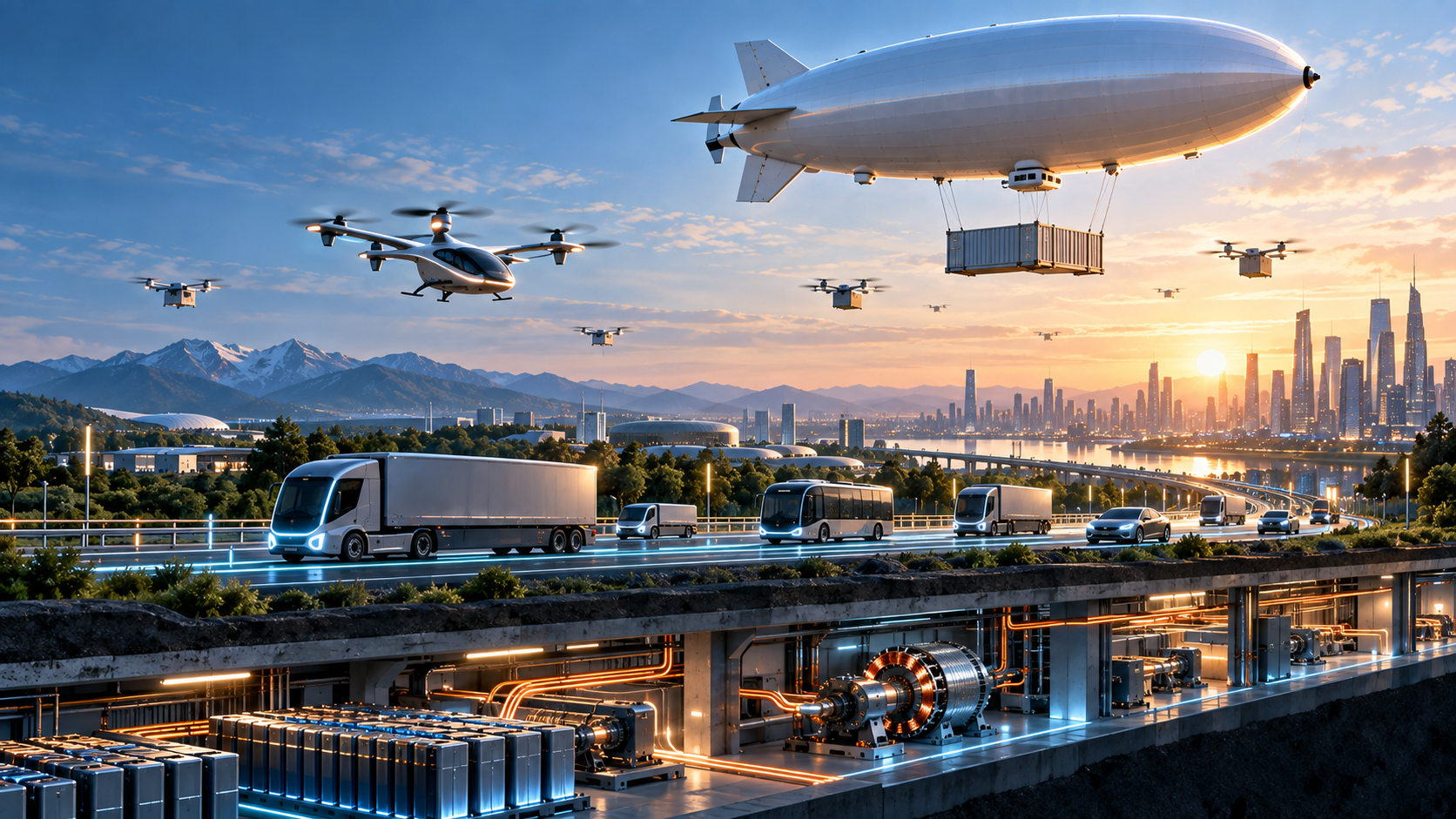
Transport technologies are part of deep tech: they require engineering development, testing, certification, and manufacturing. Their path to market is longer than that of digital services, but their impact is also greater.
There are three reasons why investors are paying attention to this field:
- A vast underlying market. People and goods will always need transportation, so even a small share of a new niche can translate into a large business.
- Government support. The transition to new forms of transport is embedded in long-term strategies, subsidy programs, and emissions requirements.
- The new-market effect. A technology that solves a problem beyond the reach of existing transport does not compete on price per kilometer; it creates a niche of its own.
Technology 1. Electrification and New Electric Motors
Electrification is the most mature area of future transport. Electric cars, buses, trucks, and light vehicles are already mass-produced. According to industry reviews, China accounts for more than 60% of global electric vehicle production.
But the electrification market is not limited to vehicles themselves. It also includes:
- electric motors and drives;
- controllers and power electronics;
- charging systems;
- technologies that improve energy efficiency.
The electric motor is the heart of every electric vehicle, and improving its efficiency delivers benefits across multiple sectors at once: transport, industry, agriculture, and household appliances.
Example. As part of the Duyunov's Motors project, Sovelmash develops and manufactures energy-efficient electric motors based on the Slavyanka combined-winding technology for industry, electric transport, agriculture, and household appliances. The company has already launched serial production and begun deliveries to customers.
Technology 2. Autonomous Transport and Unmanned Vehicles
Autonomous technologies are moving from pilot projects into real-world operation. As of early 2026, Waymo operates more than 2,500 robotaxis in 10 US cities and provides around 450,000 paid rides per week. Autonomous trucks are entering commercial service in logistics, mining, ports, and on highways. Russia, the United States, China, and Singapore are testing autonomous trucks, taxis, and buses.
The benefits of autonomy include:
- reducing human error and improving safety;
- addressing driver shortages;
- lowering operating costs;
- optimizing routes and saving energy.
Autonomy also matters in aviation. Unmanned aircraft, from delivery drones to large cargo platforms, make transportation possible in places where crewed aircraft are too expensive.
Technology 3. Urban Air Mobility
Urban and regional air mobility includes electric vertical takeoff and landing aircraft (eVTOL), air taxis, and delivery drones. Their purpose is to ease pressure on ground transportation and reduce travel times within and between metropolitan areas.
The field is at the testing and certification stage. The first commercial routes are expected in the coming years, while mass adoption depends on infrastructure (vertiports), air traffic management rules, and lower aircraft costs. The European mobility strategy explicitly calls for supporting the deployment of drones and unmanned aircraft.
Technology 4. New Batteries and Energy Storage Systems
Solid-state batteries are considered one of the key breakthroughs for transport. Their advantages include:
- higher energy density;
- greater safety;
- faster charging;
- longer service life.
According to the World Intellectual Property Organization (WIPO), the number of published patent families in solid-state battery technology grew from around 290 in 2010 to more than 2,000 in 2023. The industry’s main challenge now is achieving mass production at an acceptable manufacturing cost.
Technology 5. Alternative Fuels
Electrification alone is not enough for heavy transport, shipping, and aviation. The following technologies are being developed for these sectors:
- hydrogen for heavy-duty trucks and trains;
- ammonia and other low-carbon fuels for ships;
- sustainable aviation fuel (SAF);
- hybrid powertrains.
This field requires substantial infrastructure investment, so it is developing through partnerships between governments and major corporations.
Technology 6. Smart Infrastructure and Artificial Intelligence
Transport is becoming a connected digital system. Cars exchange data with infrastructure, traffic lights adapt to traffic flow, and AI platforms optimize routes, capacity utilization, and maintenance. Mobility as a Service (MaaS) models are also evolving, allowing trips across different modes of transport to be paid for in a single app.
For investors, this field is attractive because digital solutions scale faster than hardware, although they often depend on the development of the physical transport systems they support.
Technology 7. Modern Airships and Lighter-than-Air Aircraft
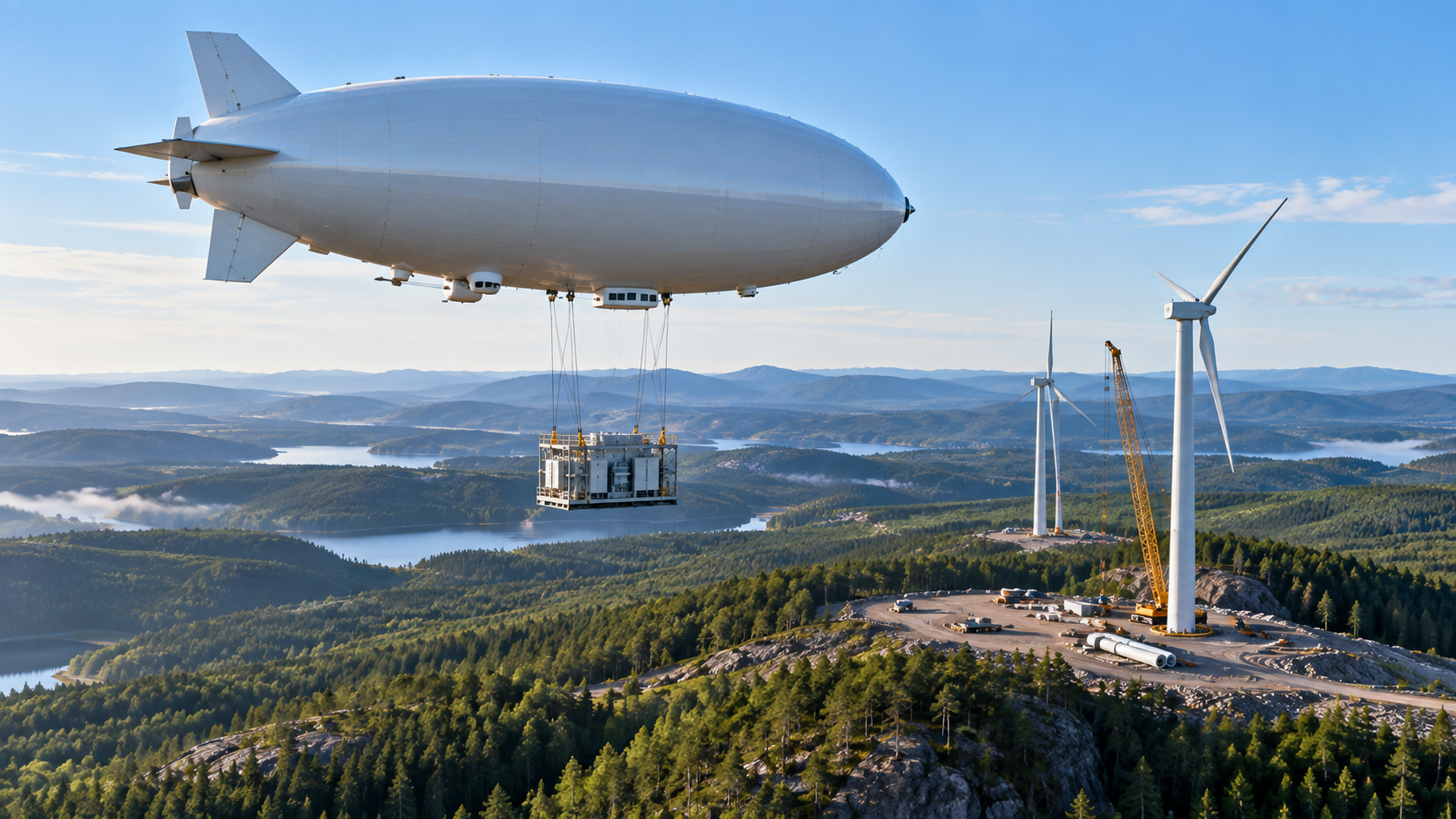
One of the most interesting niches in future transport is the revival of lighter-than-air aircraft using modern technologies. Modern airships use nonflammable helium, new envelope materials, digital control systems, and electric and hybrid powertrains.
The airship’s main advantage is its ability to carry large, heavy cargo from point to point without roads, airfields, or runways. This opens up use cases for which conventional transport offers no cost-effective solution:
- delivering heavy and oversized equipment to remote sites;
- servicing mining, energy, and oil and gas sites;
- logistics in regions without road networks;
- emergency and humanitarian deliveries;
- monitoring territories and infrastructure;
- tourism and passenger transportation.
Interest in this field is growing worldwide. In the United Kingdom, Hybrid Air Vehicles has begun the type certification program for its hybrid Airlander 10. In France, Flying Whales is developing the LCA60T cargo airship with a payload capacity of 60 tonnes. In the United States, LTA Research is testing the Pathfinder 1 airship. Several independent programs in different countries are testing the same hypothesis: lighter-than-air aircraft have a distinct place in the future transport system.
The New Generation Airships Project
New Generation Airships is a project to develop, manufacture, and commercially operate innovative airships, implemented by AERONOVA. The project is being developed on the SOLARGROUP platform, an international IT platform that facilitates investment and has organized funding for technology projects through crowdinvesting since 2017.
What has already been accomplished:
- the unmanned NOVA-01 and hybrid AEROLЁT-01 have been assembled and are undergoing flight tests; on August 1–2, 2026, the airships were deployed for the first time at the VIVA AVIA! festival in Novosibirsk, where NOVA-01 led the aeronautics program;
- the company launched its own envelope manufacturing operation, where production of the full-scale NOVA-2 envelope, with a volume of 2,000 m³ and a length of 43.2 m, was completed on August 19, 2026;
- on September 1, 2026, the envelope was inflated with air for the first time, and the initial strength-testing cycle was completed successfully; the envelope passed an overpressure test, while the ballonnet passed a leak-tightness test with no unacceptable leaks or deviations;
- the NOVA-2 design is fully complete, while its empennage, gondola, metal structures, onboard electronics, and battery systems are being manufactured in parallel; by September 22, 2026, AERONOVA had moved on to final assembly of NOVA-2;
- the team developed a technology for the controlled recovery of payloads from stratospheric launches: once the mission is complete, a light glider separates from the stratospheric balloon and returns the equipment to the launch area or a designated location.
The aircraft lineup reflects several future transport trends at once:
| Trend | How It Is Reflected in the Project |
|---|---|
| Electrification | The unmanned electric cargo version, NOVA-2E |
| Autonomy | The unmanned NOVA-01 and NOVA-2E aircraft |
| Hybrid Powertrains | The hybrid AEROLЁT-01 aircraft |
| Passenger Air Mobility | A crewed version of NOVA-2 for one pilot and five passengers, powered by two ULPower helicopter engines |
| Stratospheric Technologies | Controlled payload recovery |
| Scaling | The roadmap calls for serial production of NOVA-8, followed by serial production of NOVA-35 |
On September 2, 2026, the New Generation Airships project moved into its 4th funding stage. By that point, the project had progressed from its first unmanned aircraft to the manufacture of a full-scale NOVA-2 envelope.
Comparison of Future Transport Technologies
| Technology | Stage of Development | Mass-Market Horizon | What It Creates |
|---|---|---|---|
| Electric Vehicles and Electric Motors | Mass Production | Already Here | Replacement of the Internal combustion engine; greater energy efficiency |
| Autonomous Ground Transport | Transition to Commercial Operation | 5–10 Years | Robotaxis, autonomous freight transport |
| Urban Air Mobility | Testing and Certification | 10–15 Years | Air taxis, drone delivery |
| Solid-State Batteries | Establishing Production | 5–10 Years | A new generation of electric transport |
| Alternative Fuels | Pilot Projects | 10–20 Years | Low-carbon ships, aircraft, and heavy-duty trucks |
| Modern Airships | Testing and construction of the first full-scale aircraft | 10–20 Years | Cargo delivery without infrastructure, new niche markets |
These horizons are expert estimates based on the technologies’ current stage of development, not forecasts of specific timelines.
How to Invest in the Transport of the Future
| Method | Company Stage | Entry Threshold | Key Features |
|---|---|---|---|
| Public Company Shares | Mature | The price of one share | High liquidity; some of the growth is already priced in |
| Thematic Funds (ETFs) | Mature | Low | Diversification across the industry |
| Venture Capital Funds | Early and Mid-Stage | High; often for qualified investors | Long time horizon, access to private companies |
| Crowdinvesting | Early and Mid-Stage | Accessible | Participation in a specific project from an early stage |
The greatest growth potential is usually concentrated in the early stages, before a technology becomes mainstream and the stock market assigns it a valuation. This is why crowdinvesting has become a way for private investors to participate in the development of specific technology companies.
On the SOLARGROUP platform, investors purchase investment shares in a project through their personal account. Specific participation terms, package availability, and payment methods depend on the project and may change, so it is best to view the current parameters in the personal account.
How to Choose a Future Transport Technology for Investment
- Does the technology solve a problem that existing transport cannot? Technologies like these create new markets.
- What stage has it reached? Are there working prototypes and test results?
- Does the company have its own manufacturing operation? This is an important sign that it is moving from an idea to a product.
- How broadly can the technology be applied? The more industries that can use it, the larger its potential market.
- How is the investor participation model structured? What does an investor receive today, and what steps are planned next?
Frequently Asked Questions
What is the transport of the future? It encompasses a range of new technologies for transporting people and goods: electric and autonomous transport, urban air mobility, new batteries, alternative fuels, smart infrastructure, and modern aircraft, including airships.
Which future transport technologies could create new markets? The greatest potential lies in technologies that solve problems beyond the reach of conventional transport: autonomous transportation, urban air mobility, and the delivery of heavy cargo without roads or airfields using modern airships.
Why are airships needed in the transport of the future? Modern airships can carry large, heavy cargo from point to point without roads or runways. This makes them promising for remote industrial sites, the energy sector, mining, monitoring, and tourism.
How can private investors invest in the transport of the future? They can invest in mature technologies through publicly traded shares and investment funds, and participate in specific early-stage projects through crowdinvesting. For example, the New Generation Airships project is being developed on the SOLARGROUP platform.
What stage has the New Generation Airships project reached? The NOVA-01 and AEROLЁT-01 test aircraft are undergoing flight tests, the full-scale NOVA-2 envelope has been manufactured and tested, and final assembly of the aircraft is underway. On September 2, 2026, the project moved into its 4th funding stage.
Conclusion
The transport of the future is already taking shape: electrification has gone mainstream, autonomous technologies are entering commercial service, and air mobility and new batteries are undergoing testing. Over the next 10–20 years, some of these technologies will create new markets, and early investors will have the opportunity to grow with them.
Modern airships address a genuine gap in the transport system: delivering heavy cargo to places without roads or airfields. The New Generation Airships project by AERONOVA has already demonstrated flying test aircraft, its own envelope manufacturing operation, and a full-scale NOVA-2 envelope, and it is now at the 4th funding stage.
This material is for informational purposes only and does not constitute an individualized investment recommendation. Crowdinvesting involves risk: financial results depend on project implementation, the development of manufacturing, sales, and subsequent corporate transformation.
Learn more about the New Generation Airships project and current participation terms in your personal account: SOLARGROUP — Registration and Project Selection.