

Investing in New Generation Airships in South Africa: AERONOVA, the Market, Opportunities and Risks

Investing in New Generation Airships: Opportunities for South African Investors
Before discussing a specific project, it makes sense to start not with the investment platform but with the economics. South Africa is a country of mining, heavy industry and energy infrastructure spread across vast distances; a country where a significant proportion of production and extraction sites are far from major cities, and export logistics is not an abstract line in a report but a daily operational challenge. South Africa is also economically connected to neighbouring countries in the region—Southern Africa as a single economic area, rather than merely the territory within one country's borders.
The central argument of this article is simple: South Africa is a country where the cost of transporting heavy equipment and access to remote sites have direct economic significance. Technologies capable of carrying large loads without a new road or runway therefore merit attention not only as aviation innovations but also as a potential infrastructure-market opportunity.
This argument leads to the question around which the entire article is structured: can a modern cargo airship occupy an economically viable niche between ground transport and costly aviation? We will examine this step by step: first South Africa's logistics and economy, then the technology itself, followed by the specific AERONOVA project and its investment model, and finally the risks and a practical checklist for conducting your own assessment.
Why Logistics Is Especially Important to South Africa's Economy
Mining
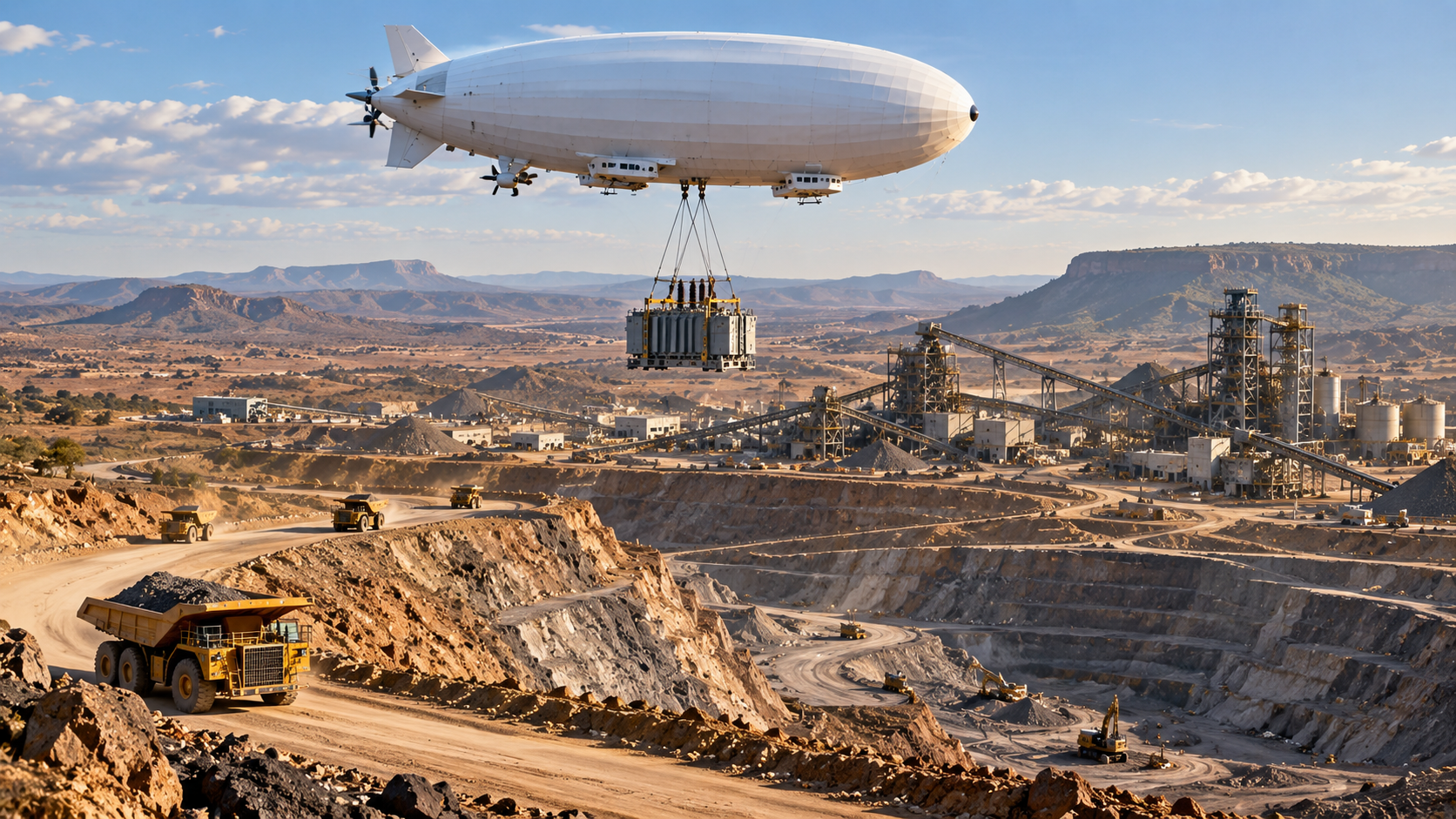
South Africa is one of the world's largest producers of platinum, gold, manganese, iron ore, coal and chromium. Many deposits and mines are far from major cities, and their operation requires a constant supply of equipment—from generators and drilling rigs to compressors and process modules—both for new construction and ongoing maintenance.
It is important not to drift into a weak argument here—that “airships will carry ore”. Moving millions of tonnes of bulk commodities is a task for which rail remains a far more logical and economical solution, and that is unlikely to change. A much more interesting proposition is delivering expensive, heavy and oversized equipment directly to a remote site, where the conventional route requires not so much the transport itself as preparation of the road.
Energy
Renewable energy projects, substations, turbine components and other energy infrastructure are often built in remote areas with limited access. The same pattern applies: large, heavy components need to be delivered to places that do not yet have a developed road network.
Industrial Construction
The construction and modernisation of industrial facilities regularly require the delivery of equipment, steel structures and large modules—a challenge similar in its underlying logic to mining and energy.
Regional Logistics
South Africa's economy is closely linked to neighbouring countries in the region—Namibia, Botswana, Zambia, Zimbabwe and Mozambique. This broadens the subject beyond a single country: the logistics pattern relevant here—delivering heavy cargo to places with poor ground infrastructure—is characteristic of Southern Africa as a whole, not only South Africa.
Where the Traditional Transport System Works Well—and Where Its Limitations Emerge
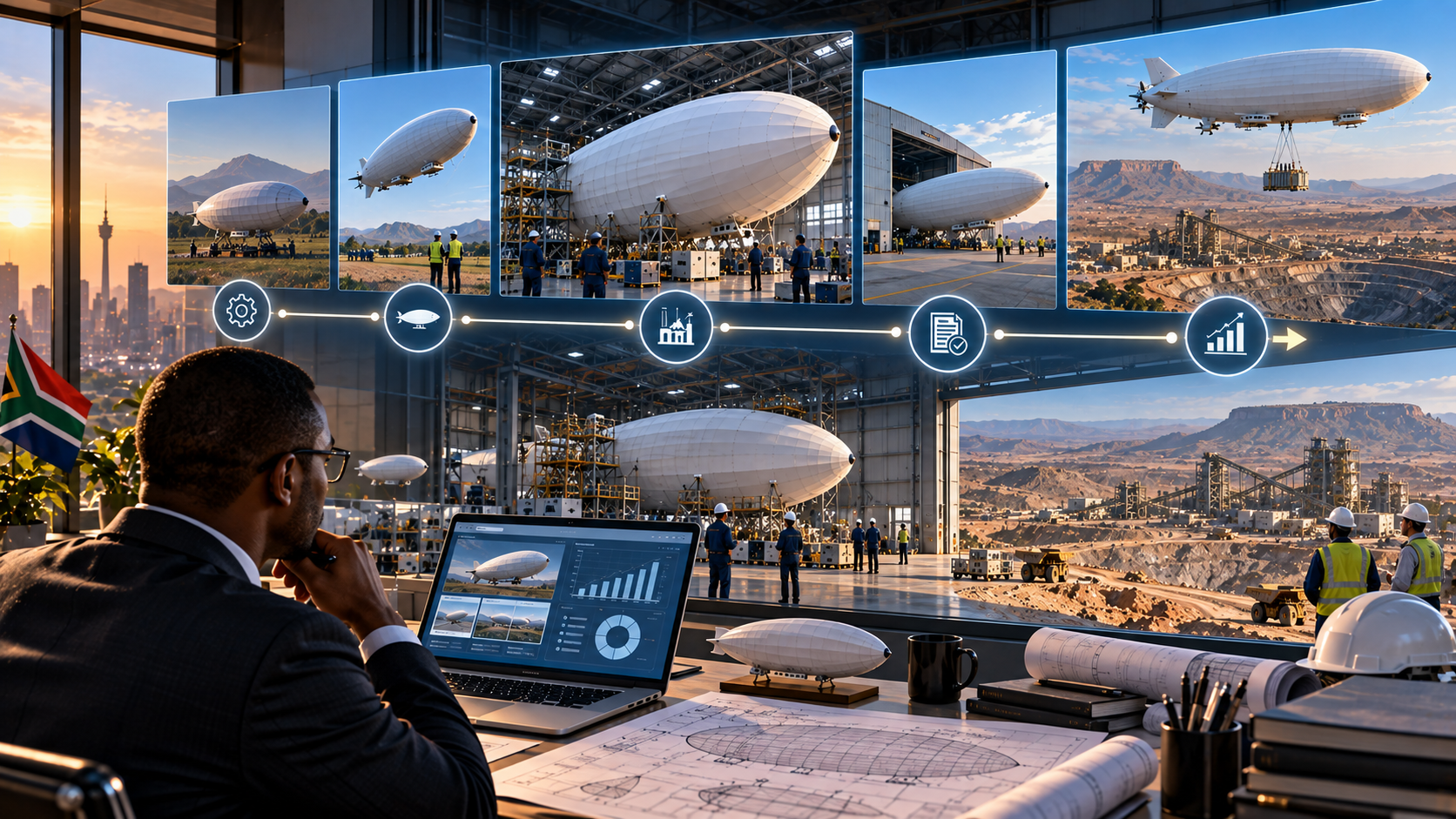
Before presenting airships as an alternative, it is worth showing honestly where existing modes of transport work well. Otherwise, the discussion becomes advertising rather than analysis.
| Mode of Transport | When It Is Effective | Limitations |
| Truck | Good roads, standard cargo, regular routes | Oversize-load permits, bridges, road width, route preparation, remote access |
| Rail | Bulk cargo, fixed corridors, large and consistent volumes | No point-to-point flexibility; tied to the existing network |
| Cargo aircraft | High speed over long distances | Requires an airport/runway; cargo-size restrictions; expensive |
| Helicopter | Access to hard-to-reach locations without infrastructure | Relatively low payload capacity; costly operating model |
This gives us the working hypothesis for the entire article: an airship is worth considering only where the cargo is too complex or heavy for a helicopter, ground delivery requires substantial infrastructure, and aircraft speed is not the main factor. It is not a universal alternative to existing transport, but a solution for a specific and fairly narrow niche.
What Is a Modern Cargo Airship?
Before going any further, it is worth dispelling two stereotypes. The first is the airship as a piece of 1930s technology, associated with the Hindenburg and the disasters of the last century. The second is the airship as a fantastical “flying ship” with no real engineering substance. Neither describes what today's projects in this field are pursuing.
Modern developments in this field use non-flammable helium instead of hydrogen, new envelope materials, digital flight-control systems, hybrid or electric propulsion systems, modern navigation and automated ground handling. At the same time, it is important to understand a key distinction from conventional aviation: a substantial portion of a modern airship's lift is generated by a lighter-than-air gas rather than wing aerodynamics. Its energy model is therefore fundamentally different from that of an aircraft—and this is not a minor detail, but the basis of the entire economics of flight.
We deliberately do not provide specific figures for fuel savings or flight costs here. Such figures are common in presentations by various companies in the sector, but there is currently not enough independently verified, comparable data for each individual project, including AERONOVA, to present them as fact.
Which South African Needs Could Potentially Be Met by Airships?
| Need | Potential Airship Use Case |
| Remote mining sites | Delivery of heavy equipment |
| Oversized industrial cargo | Point-to-point transport without a complex road route |
| Renewable energy | Delivery of large components |
| Power-grid infrastructure | Equipment delivery to remote areas |
| Remote construction | Materials and machinery |
| Cross-border logistics in Southern Africa | Delivery to areas with poor infrastructure |
| Emergency response | Operations when ground access is disrupted |
| Forestry/monitoring | Access to hard-to-reach areas |
An important caveat: these are potential applications of the technology in principle, not existing AERONOVA contracts in South Africa. The supplied data contains no evidence of the project's commercial activity in South Africa; we return to this point explicitly later in the article.
The Strongest Use Case for South Africa: Mining Logistics
Consider a hypothetical but realistic example. A mining company needs to deliver a generator, transformer, drilling rig, compressor, process module or other oversized equipment to a remote site.
The conventional journey for such cargo may require special trailers, oversize-load permits, a route survey, bridge reinforcement or diversions, road widening, temporary removal of infrastructure along the way, and sometimes construction of the final stretch of road specifically for the load. Each of these items costs time and money, often as much as the transport itself or even more.
The proposition for an airship here is as follows: if the aircraft can lift such a load and deliver it directly to the site, in some scenarios the economic value comes not from a cheaper flight in itself, but from eliminating some of the infrastructure costs associated with the shipment.
This distinction is central to the entire article: an airship competes not with a truck's cost per kilometre, but with the total cost of delivering a particular heavy and oversized load to a particular location without developed infrastructure.
Why Comparing Only the “Cost per Kilometre” Is Misleading
Total Logistics Cost Matters More Than the Cost of a Single Kilometre
The total cost of logistics comprises much more than the transport tariff:
- The cost of the transport itself
- Preparing infrastructure for the cargo (roads, bridges and sites)
- Permits and approvals
- Loading and unloading
- Downtime and delays
- Specialised equipment
- Last-mile delivery
It is the sum of all these items that should be compared with an alternative delivery method—not the cost per tonne-kilometre in isolation. An airship may well cost more than a truck per kilometre travelled, yet could theoretically be more economical for a specific oversized load in a remote location by reducing precisely these associated costs. The reverse is also true: where a good road has already been built and is operating, a truck will almost certainly remain the more logical choice. The new technology offers no universal advantage.
Airship vs Truck, Helicopter and Cargo Aircraft
| Parameter | Truck | Helicopter | Cargo Aircraft | Airship |
| Road required | Yes | No | No | No |
| Runway required | No | No | Yes | Potentially not required |
| Speed | Medium | High | Very high | Low |
| Payload scalability | High | Limited | High | Potentially high |
| Oversized cargo | Route restrictions | Limited | Cargo-hold restrictions | Potential advantage |
| Point-to-point delivery | By road only | Yes | No | Potentially yes |
| Commercial maturity of the industry | Very high | High | High | Low |
| Technology risk | Low | Low | Low | High |
Why Projects Like This Should Be Viewed as Deep Tech Investments
A conventional digital start-up is primarily about software, a relatively quick MVP, low CAPEX and finding product-market fit through rapid iteration. Aerospace deep tech is fundamentally different: engineering design, prototyping, manufacturing, testing, certification and physical infrastructure—with substantially higher CAPEX required for years before a commercial product emerges.
This leads to the section's central argument: an investor in aerospace deep tech is effectively investing not in a finished product, but in the successive reduction of technological and commercial risks—step by step, as the project passes through engineering and regulatory milestones.
What De-risking an Aviation Project Looks Like
- Concept
- Engineering design
- Small-scale demonstrator
- Demonstrator flight tests
- Larger prototype
- Manufacturing capabilities
- Certification
- First commercial aircraft
- First customers
- Serial production
The more of these stages have actually been completed—with tangible results that can be seen and verified—the less the project resembles an idea in a presentation. It is important, however, not to confuse “more stages completed” with “the project is ready”. Even on the upper rungs of this ladder, there may still be a long way to go before the company reaches commercial maturity. Below, we show frankly exactly where AERONOVA stands today.
What Is the New Generation Airships Project?
New Generation Airships is a project to develop, manufacture and commercially operate airships, implemented by AERONOVA, a company established specifically for this purpose. SOLARGROUP is not the aircraft developer: the platform acts as a co-founder of AERONOVA and organises collective financing. Payments are accepted and the transaction is legally formalised through the SOLARGROUP back office.
The stated goal is a family of modern airships for different purposes, ranging from unmanned cargo aircraft to crewed versions and special-mission aircraft. Below, we distinguish what has actually been accomplished from what remains a plan.
What AERONOVA Has Already Accomplished
NOVA-01 and AEROLЁT-01
NOVA-01 is an unmanned airship created as a dynamically similar model of NOVA-2 to test control systems and flight modes; the aircraft has been assembled and is undergoing flight tests. AEROLЁT-01 is a hybrid experimental aircraft that has also been assembled and is being tested. In August 2026, the team reported that it had successfully demonstrated hovering and position holding after upgrading the mechanisms that rotate the propeller-motor frames.
NOVA-2
On 19 August 2026, the final weld was completed on the NOVA-2 envelope at AERONOVA's own production facility. The envelope has a volume of 2,000 m³, a length of 43.2 m and a maximum diameter of 9.6 m. It was delivered to the assembly site in Kirzhach, inflated with air on 1 September 2026, and put through its first cycle of strength tests. Gas-permeability and ballonet tests are scheduled next, after which the envelope is to be integrated with the aircraft's other systems. The tail assembly, gondola, metal structures, onboard electronics and battery systems remain in production.
Production Facilities
AERONOVA operates at several sites: its office and design bureau are in Moscow, near Voykovskaya metro station; its own envelope-production facility is in Lyubertsy, in a workshop covering approximately 800 m², where fabric panels are cut, seams welded and envelope components manufactured; and its assembly site is the rented left half of a hangar at the airfield in Kirzhach, Vladimir Region, originally built for two AU-30 airships. The data confirms that this site is rented; the purchase of the Kirzhach airfield has not been confirmed.
Regulatory Matters
AERONOVA has obtained a licence from the Ministry of Industry and Trade of the Russian Federation to develop aerostatic aircraft. Project materials sometimes describe this licence more broadly—as perpetual and also covering manufacturing and operation—but, at present, the independently verified formulation is the narrower one granting the right to conduct development. The broader scope should be checked against the project's official documents at the time of your decision.
The team also says it is preparing to obtain a developer certificate from Rosaviatsiya. This is a future milestone, not a document already obtained, and it should be monitored separately from the licence already issued by the Ministry of Industry and Trade.
AERONOVA's chief designer is Vadim Zubkevich, and its chief microturbine designer is Andrey Kostyukov.
Why NOVA-2 Is Especially Important to Investors
NOVA-01 showed that the team can design, build and fly a smaller-scale aircraft—an important result, but one of limited significance. NOVA-2 must answer fundamentally different questions: how the technology behaves when scaled up; whether the large-envelope manufacturing process is repeatable; how the structural components, propulsion system and control system integrate with one another; and how the aircraft performs during ground handling and actual flight.
In other words, NOVA-2 is not merely “the next aircraft in the numbering sequence”, but the next level of technological de-risking on the ladder described above. For an investor, progress on this particular aircraft carries far more weight than another presentation containing a market forecast.
What AERONOVA Still Needs to Prove
- Completion of NOVA-2 as an integrated aircraft, rather than merely a completed envelope
- Ground testing of the assembled aircraft
- NOVA-2 flight tests and verified flight performance
- Manufacturing repeatability—the ability to build not just one aircraft, but a series of aircraft of consistent quality
- Progression to larger models in the range (NOVA-8 and beyond)
- Certification—including the stated Rosaviatsiya developer certificate and, in the longer term, type certification for the aircraft itself
- Verified commercial economics for the project, not only engineering results
- First real customers
- Scaling up production and sales
AERONOVA is therefore best described today as a project positioned between the experimental engineering stage and a future commercial aviation business—not at the starting point of an idea, but not at the destination either.
Is There Actually a Global Market for Modern Airships?
A natural question for readers is: why believe that anyone needs airships today? The answer is that AERONOVA is not the world's only project in this field.
LTA Research (United States) is building the Pathfinder 1 rigid airship. The aircraft made its first untethered flight in October 2024 and has since been undergoing a test programme in the San Francisco Bay Area. Its stated capacity is 2 crew members and 12 passengers, but the specific commercial niche and market-entry timetable have not been publicly disclosed; the project is still described as a test platform.
Hybrid Air Vehicles (United Kingdom), with its hybrid Airlander 10 aircraft, has advanced further along the regulatory path. The company has begun the type-certification process with the UK Civil Aviation Authority (CAA), states that the first flight will take place in 2026 and entry into service in 2028, and reports a preorder for 20 aircraft from regional airline Air Nostrum. Its target applications are passenger transport, logistics and tourism, with capacity for up to 100 passengers or 10 tonnes of cargo.
Flying Whales (France) is developing the heavy-lift LCA60T cargo airship with a payload capacity of 60 tonnes—the closest conceptual competitor for the South African scenario. Its stated applications include transporting energy equipment, humanitarian missions, logging and industrial logistics specifically in remote areas without developed road infrastructure. The aircraft's propulsion system is still under development, and precise timelines for certification and serial production have not been published.
The mere existence of several independently funded programmes does not prove that airships will become a mainstream mode of transport. It does, however, show that industrial investors and engineering teams in different countries are independently testing a similar hypothesis: there is a niche for oversized cargo transport with minimal ground-infrastructure requirements.
Source: LTA Research, Pathfinder 1 programme materials; Hybrid Air Vehicles, Airlander 10 certification announcements, 2026; Flying Whales, LCA60T technical materials
AERONOVA Compared with Other Airship Developers
| Company | Concept | Stage | Primary Use Case | What Matters to Investors |
| AERONOVA | Light/hybrid airship, with electric and petrol versions | NOVA-2 envelope completed and tested; aircraft assembly in progress | Cargo, passenger transport and special missions | Early stage: high growth potential with high risk |
| LTA Research | Rigid airship | Pathfinder 1's first flight took place in 2024; test programme continues | Presented as a research/testbed platform; specific commercial niche undisclosed | Substantial company resources, but no commercial timeline announced publicly |
| Hybrid Air Vehicles | Hybrid airship (Airlander 10) | UK CAA type certification initiated; first flight stated for 2026, entry into service for 2028 | Passenger transport, logistics and tourism | Longer development history and preorders already announced |
| Flying Whales | Heavy-lift cargo airship (LCA60T, 60 t) | Development ongoing; propulsion system being refined | Heavy cargo to remote areas/areas lacking infrastructure | The competitive proposition most similar in concept to the South African scenario |
Competition is both a risk for AERONOVA—the same niches interest other teams, some with greater resources—and evidence that the market hypothesis is not confined to a single company.
Why South Africa Is a Potentially Attractive Market for This Technology
| Characteristic of South Africa | Why It Is Relevant |
| Large mining sector | Ongoing need to transport heavy equipment |
| Long distances | Logistics is a significant business expense |
| Remote industrial sites | Demand for delivery with minimal infrastructure requirements |
| Energy transition | Logistics for large components used in new power generation |
| Regional role in Southern Africa | Potential expansion into neighbouring countries |
| Limitations of existing infrastructure | A niche for alternative logistics |
It is important, however, to state this plainly: AERONOVA has not announced any commercial activity in South Africa. Everything written above and below in this section is an analysis of the technology's potential market relevance to the South African economy, not a description of existing AERONOVA projects, contracts or partnerships in the country.
Southern Africa as a Larger Potential Market
It is important to look beyond a single country. An investor in this technology is effectively buying into a hypothesis not about “one airship for South Africa”, but about logistics across an entire region: Botswana's mining industry, Zambia's copper sector, and mining and energy projects in Namibia, Mozambique and Zimbabwe.
Care is needed in how this is expressed: the issue is market relevance—the economic pattern recurring across the region—not verified customers or deals. The section's argument is that the potential market for a new transport technology may be shaped not by national borders but by industrial corridors and regions with remote resource sites.
What an Airship's Commercial Model Might Look Like
- Sale of aircraft to operators — Aircraft sales
- Leasing — Leasing the aircraft to an operator or customer
- Transport as a service — The company carries out the transport itself as the transport operator
- Special missions — Monitoring, emergency response and specialised industrial tasks
A natural question follows: which of these models will become AERONOVA's main source of revenue? The supplied project data does not directly answer this question. In that case, it is more honest to say plainly that the monetisation model—in terms of specific figures and priorities—still needs to be clarified using the project's current materials rather than inferred independently.
Where Value for Investors Could Potentially Come From
The logic of value growth in projects of this kind usually takes the form of a chain rather than a single event: engineering achievements reduce technology risk → this makes larger prototypes possible → progress in certification → readiness for production → commercial orders → revenue → potential growth in the value of the business.
An important caveat is often overlooked: an increase in the company's value does not automatically mean that an investor receives money. Between “the company has become more valuable” and “the investor has earned a return” lies another step—a specific mechanism for converting and monetising the investor's stake, which we examine in the following sections.
Financing AERONOVA
The project's overall funding target is $100 million, divided into 20 stages. According to an official SOLARGROUP publication dated 26 August 2026, 1 September was the final day of funding stage 3, and the project was to move to stage 4 on 2 September. At the time this article was prepared, it was not possible to find independent confirmation that the transition had been completed, or of the stated final figures for stage 3 ($5 million raised, a total fund of more than $15.5 million and over 14,200 participants). The current status should be checked in the platform's back office. An earlier verified snapshot shows that $14,230,834 had been raised as of 18 June 2026.
Why an Aerospace Start-up Needs This Much Money
The figure of $100 million seems abstract until it is broken down into the types of expenditure typical of such projects: R&D and engineering design, prototype construction, materials—primarily envelopes and load-bearing structural elements—propulsion systems and engines, manufacturing itself, the rental and maintenance of hangars and sites, the ground- and flight-test programme, certification, personnel, and working capital throughout this period. Viewed this way, the figure reads not as an abstract “fundraising target”, but as the budget for a multi-year industrial programme.
What the Investor Receives Legally
This is one of the most important sections for an investor, and the wording here must be exceptionally precise, without smoothing over the details.
Technically, a participant buys investment shares through SOLARGROUP, rather than shares in AERONOVA directly. Once funding is complete and AERONOVA has been converted into a joint-stock company, the project model provides for the issue of 1 billion shares: 490 million are intended for investors, while 510 million—the controlling interest—remain with the company. Under the model presented, 100 investment shares would be exchanged for one company share. AERONOVA's target valuation is at least $1 billion, implying an estimated value of approximately $1 per company share and about $0.01 per investment share. This is specifically an estimate under a future model, not a verified market price.
An important methodological caveat: AERONOVA's investment model must not automatically be described using the model of another project on the platform (Duyunov's Motors/Sovelmash) without checking the current contract for AERONOVA specifically. Each project on the platform may have its own transaction structure, and the terms of one project should not be transferred to another without verification.
Below are questions that should be answered precisely using the current contract before investing a significant amount, rather than relying on a general description of the model in this or any other article:
- What exactly is acquired when the package is paid for—an investment share, a claim, or another legal instrument?
- How are the investor's rights structured when SOLARGROUP acts as intermediary?
- Are the future shares for which the investment shares are to be exchanged shares in AERONOVA itself?
- Who is the counterparty to the contract—the platform, the project company, or a third party?
- What are the precise terms and timing of the future conversion of investment shares into company shares?
- Can the rights under the contract be transferred or sold to another person?
- Which jurisdiction's law governs the contract?
If the specific contract available at the time of your decision does not provide an unambiguous answer to any of these questions, you should explicitly record it as an open risk rather than make assumptions in your own favour.
You can most easily review the current contract, stage 4 status and participation terms directly in the platform's back office before making a decision: SOLARGROUP — Registration and Project Materials.
Can an Investor from South Africa Participate?
Here is a brief answer, without duplicating the detailed analysis of international investment that deserves a separate article. South Africa has an exchange-control regime administered by the South African Reserve Bank (SARB). An individual may transfer up to 2 million rand abroad each year under the Single Discretionary Allowance without obtaining tax clearance from the South African Revenue Service (SARS). Larger amounts can be transferred under the additional Foreign Investment Allowance of up to 10 million rand a year, but SARS tax clearance is then mandatory. Any such transfer must pass through an authorised intermediary—a bank or other authorised dealer—rather than being made directly.
The supplied project data contains no separate programme for South African investors: there are no documented special packages, discounts, local legal structure or verified AERONOVA commercial projects in South Africa. For a South African investor, participation is therefore technically structured as an ordinary investment of personal funds in a foreign crowdinvesting project, subject to the general SARB exchange-control rules and the declaration of income for SARS tax purposes—not to any arrangement created specifically for the country.
These are general guidelines, not individual advice. The specific thresholds, documentation requirements and tax treatment of income from foreign investments should be checked with an authorised dealer—a bank—and a South African tax adviser before transferring an amount that is significant to you.
Source: SARB exchange-control framework; Single Discretionary Allowance and Foreign Investment Allowance limits, 2026 (FinGlobal, Sable International)
AERONOVA's Key Risks
| Risk | Why It Matters | What to Watch |
| Technology | Scaling from NOVA-01 to NOVA-2 and beyond may not produce the expected result | NOVA-2 test results |
| Flight performance | The aircraft's actual parameters may differ from the stated targets | Flight-test data |
| Certification | May require more time and funding than planned | Progress towards the Rosaviatsiya developer certificate and subsequent milestones |
| Manufacturing | A successful prototype does not amount to established serial production | Demonstration of a repeatable production cycle |
| Financing | The project may require more capital than provided for in the current stages | Fundraising progress by stage |
| Demand | The market for a new transport technology may develop more slowly than expected | Emergence of verified customers |
| Competition | Other airship developers may outpace AERONOVA in key niches | Progress by LTA Research, HAV, Flying Whales and other participants |
| Economics at scale | An economic advantage over traditional transport has not yet been demonstrated in real-world operations | Initial commercial operations and their economics |
| Investment liquidity | This is a private, unlisted investment that has no public trading market | Terms governing the transfer of rights under the specific contract |
| Legal and jurisdictional matters | The investor's rights are defined by the specific contract and its jurisdiction | Contract terms at the time of investment |
| Currency risk | The investment's value in rand depends on the rand's exchange rate against the investment currency | ZAR exchange-rate movements against the platform's currency |
Bull Case/Base Case/Bear Case
Bull Case
- NOVA-2 successfully completes all tests
- Certification progresses according to plan
- The next, larger model in the range confirms scalability
- Verified customers emerge
- The airship market niche expands
- The company's valuation rises as it makes progress
Base Case
- The technology works overall, but development takes longer than stated
- The market remains niche for longer than expected
- Additional funding is required beyond the current 20 stages
- Commercialisation proceeds more slowly than originally planned
Bear Case
- Problems arise when scaling up the design
- Certification is substantially delayed
- The project's economics prove weaker in practice than expected
- Demand for commercial operations is insufficien
- The project requires restructuring or substantial additional funding
This is not a return forecast, but a scenario analysis: none of the three scenarios is guaranteed, and the purpose of this section is to show the range of realistic outcomes, not to predict a specific result.
What Investors Should Monitor over the Next 12–24 Months
- Completion of NOVA-2 as an integrated aircraft
- Results of ground and strength tests
- NOVA-2's first flight
- Published flight performance following the tests
- Progress towards the Rosaviatsiya developer certificate
- Expansion of manufacturing capabilities
- Progress on larger models in the range (NOVA-8 and beyond)
- Emergence of commercial proposals or orders
- Fundraising progress by stage
- Legal and corporate changes relevant to investors (transaction structure, conversion into a joint-stock company)
The more of these milestones are substantiated by real results rather than merely announced, the less the project's investment case will depend on its initial promises.
How to Conduct Your Own Due Diligence on AERONOVA
- Technology — Have aircraft actually been built and tested, rather than existing only as renderings and presentations?
- Team — Who are the developers, and what verifiable professional experience do they have?
- Manufacturing — Where exactly are key components made, and are they produced in-house or by a contractor?
- Certification — Which permits and approvals have already been obtained, and which are still pending?
- Market — Who might theoretically be willing to pay for this type of transport, and why?
- Competition — Who else in the world is addressing the same need, and what stage have they reached?
- Finance — How much funding does the project need in total, and how much has been raised to date?
- Legal matters — What exactly is the investor acquiring and on what terms, according to the current contract rather than a general description of the model?
- Exit — How can the investment potentially be monetised, and under what conditions?
- Country-specific considerations — Can a South African resident legally complete this particular transaction under SARB and SARS rules?
Who This Investment May Suit—and Who It May Not
Potentially Suitable
An investor who understands the investment's high risk, has a long investment horizon, already has a diversified portfolio, is prepared for low liquidity, is interested in deep tech and views this investment as a small, speculative part of a portfolio rather than its main asset.
Probably Not Suitable
If you will need the money in 1–2 years, if it is an emergency reserve, if you require a guaranteed return, if you are not prepared for the possibility of losing the entire amount invested, or if you do not fully understand the transaction structure and legal terms, then an investment in this type of project is unlikely to suit your circumstances.
Frequently Asked Questions
Why Might Airships Be of Interest to South Africa?
Because of the combination of a large mining industry, long distances and remote industrial sites, where delivering heavy and oversized equipment without developed road infrastructure is already a real and costly challenge.
Will Airships Replace Trucks and Rail?
Based on the available data about the technology and market, no. The proposition is not to replace trucks and rail, but to complement them in a narrow niche: where cargo is too heavy and oversized for a helicopter, while ground delivery requires substantial infrastructure preparation.
Which Aircraft Has AERONOVA Already Built?
NOVA-01 (unmanned) and AEROLЁT-01 (hybrid) have been assembled and are undergoing flight tests. The NOVA-2 envelope has been manufactured and completed its first cycle of strength tests; assembly of the aircraft itself continues.
Is NOVA-2 Already Flying?
At the time this article was prepared, no: completion and strength testing of the envelope have been confirmed, but not flight of the assembled aircraft. This is one of the key indicators to monitor.
Does AERONOVA Have Verified Customers in South Africa?
No. The supplied project data does not document any such customers or contracts in South Africa.
Are Other Companies Developing Modern Airships?
Yes. They include LTA Research and Hybrid Air Vehicles with passenger and multi-purpose models, as well as Flying Whales with the heavy-lift LCA60T cargo airship; each company is at a different stage of development.
What Funding Stage Has the Project Reached?
According to an official SOLARGROUP publication dated 26 August 2026, the transition to stage 4 of 20 planned stages was scheduled for 2 September 2026. At the time this article was prepared, it was not possible to independently verify the final figures for stage 3—the stated $5 million raised and total project fund of more than $15.5 million. The current status should be checked in the platform's back office.
What Exactly Does the Investor Receive?
Technically, the investor receives an investment share through SOLARGROUP, under a stated model providing for its subsequent exchange for shares in AERONOVA once funding is complete. The precise terms should be checked in the current contract rather than inferred from a general description of the model.
Is Growth in the Investment's Value Guaranteed?
No. The valuation and investment-share value targets are estimates under a model, not a guarantee or a current market price.
When Can Dividends or a Return Be Expected?
No precise timeframe can be guaranteed. It depends on the project's own progress—testing, certification, manufacturing and the generation of commercial revenue.
Can the Investment Be Sold Before the Project Is Complete?
That depends on the terms of the specific contract and the mechanism it provides for transferring rights. This should be clarified in advance, rather than assumed by analogy with other forms of investment.
Can a South African Resident Legally Invest in This Project?
Technically, transfers of small and moderate amounts fall within the existing SARB allowances—the Single Discretionary Allowance and Foreign Investment Allowance—when made through an authorised dealer. The project data contains no special terms for South Africa, so the general rules apply. For a significant amount, consult a bank acting as an authorised dealer and a South African tax adviser.
Conclusion
South Africa is one of the markets where the investment hypothesis for cargo airships can be explained particularly clearly through the existing economy: resource extraction, heavy industry, energy, long distances and remote production sites. This does not mean that airships will replace rail, trucks or aircraft. On the contrary, the technology's potential market exists only where the advantages of point-to-point delivery of heavy cargo can offset the lower speed and technological immaturity of a new mode of transport.
AERONOVA has already moved beyond the idea stage: experimental aircraft have been built and are being tested, the company has established its own envelope-production facility, and the NOVA-2 envelope has been manufactured and completed its first cycle of strength tests. But the most important commercial stages still lie ahead—assembly of the complete aircraft, flight tests, certification, repeatable production and proof of real demand, including outside Russia.
An investment in the New Generation Airships project is therefore best viewed as an early-stage, high-risk deep tech investment in which potential growth in value depends on the progressive reduction of technological, manufacturing and commercial risks—not as a finished financial product with predictable returns.
You can review the latest NOVA-2 progress, stage 4 status and contract directly in the platform's back office; registration does not commit you to anything: SOLARGROUP — Explore the Project.