


Why Logistics Is Becoming a Compelling Area for Technology Investment

Why Logistics Is Becoming a Compelling Area for Technology Investment
In one sentence: Logistics is a vast and essential industry facing cost pressures and instability, so technologies that make delivery faster, cheaper, and more accessible are in steady demand from businesses.
Introduction
Every item around us—from a smartphone to a machine tool in a factory—has passed through a logistics chain. Transportation, warehousing, customs, the “last mile,” and supply chain management make up one of the largest sectors of the global economy. According to independent analytics firms, the global logistics market is worth trillions of dollars.
We will examine:
- why logistics attracts technology investors;
- which areas of logistics technology are growing fastest;
- which challenges traditional transport has yet to solve;
- what niche modern cargo airships could occupy.
Why Logistics Needs Technology
The industry faces several challenges at once. The Descartes 2025 Forwarder/Broker Benchmark Study, published in late 2025, shows that freight forwarders and customs brokers see the following as their main challenges for the coming years:
- pricing pressure—61% of respondents;
- global instability—60%;
- changes in import tariffs—42%.
At the same time, 67% of respondents consider technology very important for growth, while 55% identify adopting new technology as their main strategy for staying ahead of competitors. Meanwhile, 65% expect artificial intelligence to deliver the greatest value over the next two years.
Technology investment priorities are also changing. According to the study’s authors, logistics companies invested in efficiency in 2019–2020 and in digitalization in 2021–2022, while the focus has now shifted to intelligent systems and automation.
Why This Is of Interest to Investors
- Steady demand. Transportation is needed in any economic climate, and in a crisis, demand for cost reduction only increases.
- Measurable impact. A logistics technology either saves money and time or it does not. This makes it easier to sell solutions to businesses.
- Scalability. A solution that works for one company or one route can be replicated across the entire industry.
- New markets. Some technologies not only reduce the cost of existing transportation but also enable deliveries that were previously impossible.
Key Areas of Technology Investment in Logistics
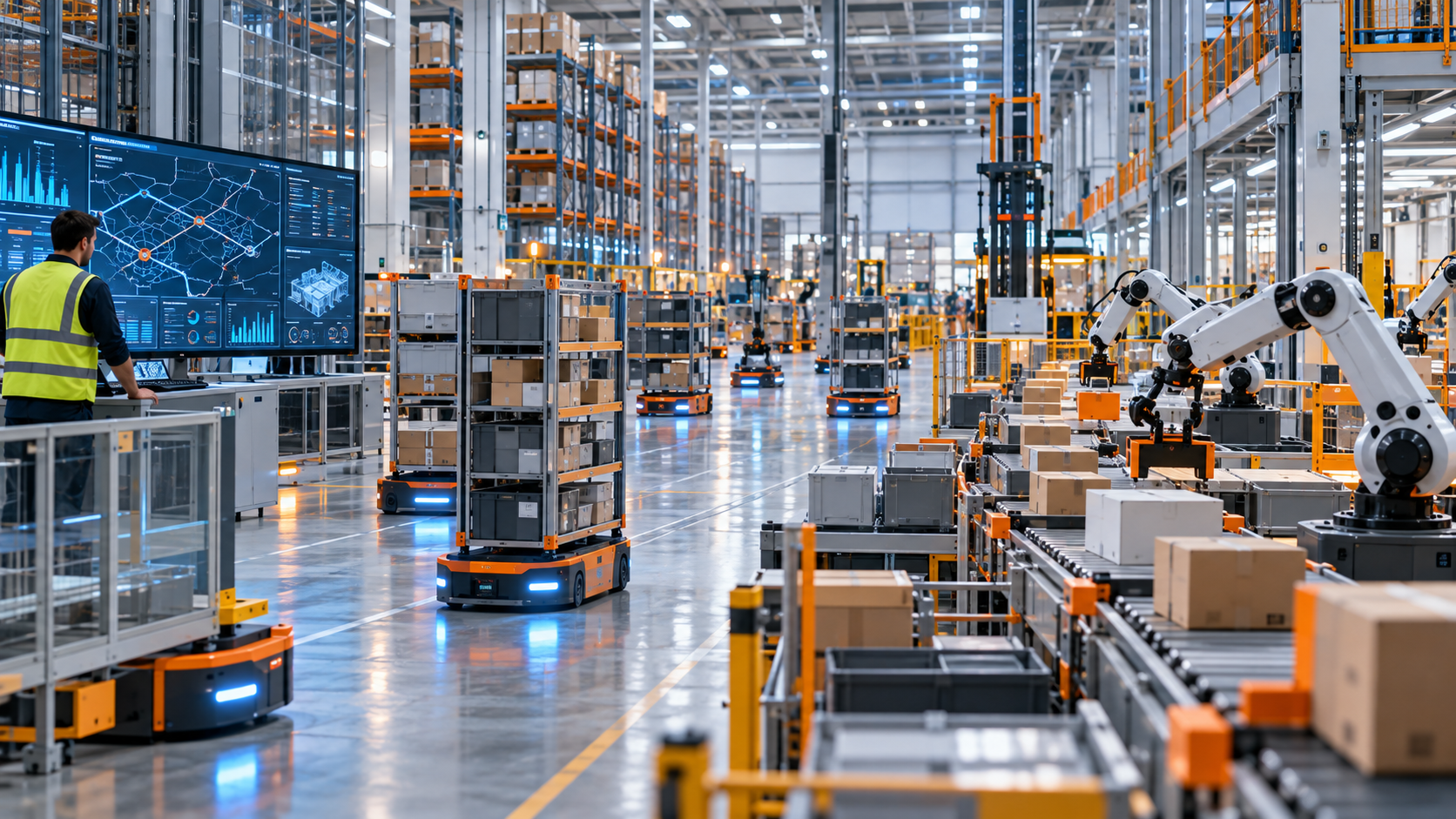
1. Digitalization and Supply Chain Visibility
Real-time freight tracking using GPS and IoT sensors has become standard practice. Transportation management systems (TMS), digital documents, and unified data platforms connect manufacturers, carriers, warehouses, and recipients. This reduces downtime, errors, and manual work.
2. Artificial Intelligence and Forecasting
AI helps forecast demand, seasonal peaks, weather risks, and customs delays, while optimizing routes and vehicle loads. According to the same Descartes study, more than half of companies (55%) are prioritizing investment in AI over the next two years.
3. Warehouse Automation
Robotic warehouses and automated sorting and order-picking systems reduce reliance on manual labor. This is especially important for the industry: about a quarter of survey respondents cite manual labor as the main barrier to growth.
4. Autonomous Freight Transportation
Autonomous trucks are moving from testing to commercial operation on highways, in ports, and at mining and industrial sites. They help address driver shortages, improve safety, and reduce fuel costs. Unmanned aerial vehicles are being used for small-cargo delivery and monitoring.
5. Electrification and Green Logistics
Electric vans and trucks, energy-efficient motors, and alternative fuels for heavy transport are a response to increasingly stringent environmental requirements. The European Union, for example, plans to double rail freight traffic by 2050 and reduce transport emissions by 90%.
6. New Modes of Transport for Challenging Routes
This area is less visible but potentially one of the most compelling. It includes technologies that can handle tasks beyond the reach of trucks, trains, and airplanes: delivering heavy and oversized cargo to places without roads or airfields.
| Area | Business Benefit | Stage of Development |
|---|---|---|
| Digitalization and Tracking | Visibility, fewer errors and less downtime | Widespread adoption |
| AI and Forecasting | Route and load optimization | Rapid growth |
| Warehouse Automation | Less manual labor, faster processing | Rapid growth |
| Autonomous Transportation | Addressing driver shortages and improving safety | Transition to commercial operation |
| Electrification | Lower emissions and energy costs | Scaling |
| New Modes of Transport | Delivery without roads or airfields | Testing and initial vehicles |
Challenges Traditional Logistics Has Yet to Solve
Existing modes of transport work very well where infrastructure is available. But a significant share of economic activity takes place far from roads and airports:
- mining operations and mineral deposits;
- oil and gas facilities and energy infrastructure;
- construction in remote areas;
- forestry;
- northern and hard-to-reach regions;
- disaster areas cut off from ground transportation.
Delivering heavy and oversized equipment to such locations—generators, transformers, process modules, and steel structures—requires specialized equipment, permits, bridge reinforcement, and sometimes even the construction of temporary roads. These expenses are often comparable to the cost of transportation itself.
Therefore, when evaluating new logistics solutions, it is important to consider not the cost per kilometer but the total delivery cost:
- transportation;
- preparation of roads, bridges, and sites;
- permits and approvals;
- loading and unloading;
- downtime and delays;
- specialized equipment;
- last-mile delivery.
A technology that eliminates some of these cost items can be economical even if transportation is slower.
Comparison of Transport Modes for Challenging Cargo
| Parameter | Truck | Helicopter | Cargo Airplane | Airship |
|---|---|---|---|---|
| Road Required | Yes | No | No | No |
| Runway Required | No | No | Yes | No |
| Oversized Cargo | Constrained by route | Constrained by lifting capacity | Constrained by cargo hold | Key advantage |
| Point-to-Point Delivery | By road only | Yes | No | Yes |
| Speed | Medium | High | Very high | Moderate |
| Infrastructure Costs | High for remote sites | Low | High | Low |
An airship does not replace a truck, train, or airplane. It complements the transport system where cargo is too heavy for a helicopter, ground delivery requires costly route preparation, and speed is not the primary consideration.
Modern Cargo Airships: A New Niche in Logistics
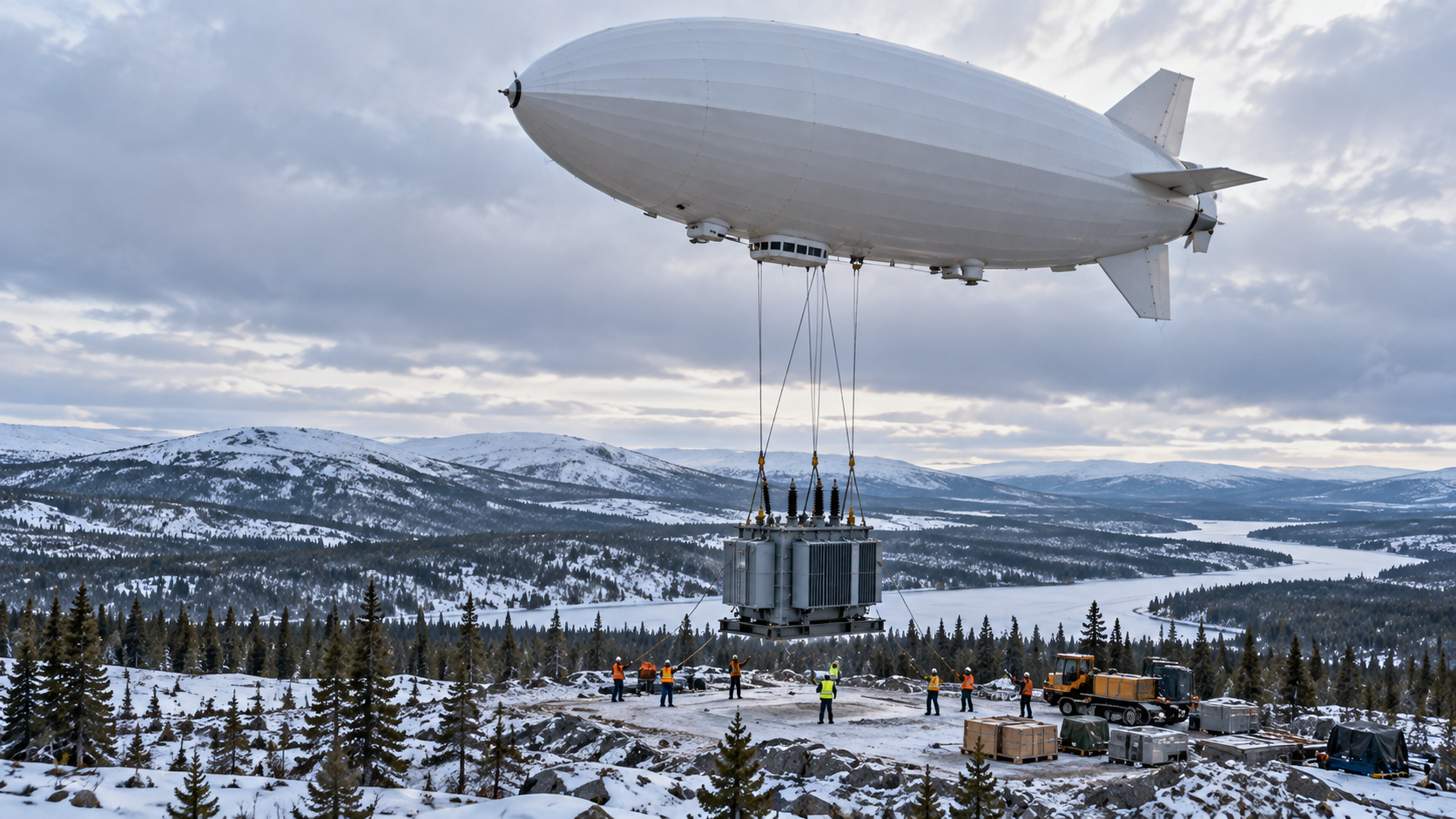
A modern airship is not a relic of the past. New designs use nonflammable helium, advanced envelope materials, digital flight control systems, and electric and hybrid powertrains; they can also be operated without a crew. Much of the lift is provided by a lighter-than-air gas, so the energy model of such a vehicle is fundamentally different from that of an airplane or helicopter.
Logistics use cases:
- delivering heavy and oversized equipment to remote sites;
- supplying mining, energy, and oil and gas sites;
- construction in areas without road networks;
- emergency and humanitarian logistics;
- monitoring linear infrastructure—pipelines, power lines, and forests.
Programs in several countries confirm interest in this niche: Flying Whales in France is developing the LCA60T cargo airship, with a payload capacity of 60 tonnes, to deliver heavy cargo to remote areas, while Hybrid Air Vehicles in the United Kingdom has begun type certification of the Airlander 10 hybrid aircraft.
The New Generation Airships Project
New Generation Airships is an AERONOVA project to develop, manufacture, and commercially operate innovative airships for passenger and freight transportation. The project is being developed on the SOLARGROUP platform, an international IT platform that facilitates investment.
What has already been accomplished:
- the unmanned NOVA-01 and hybrid AEROLЁT-01 have been assembled and are undergoing flight tests;
- on August 1–2, 2026, AERONOVA participated in the VIVA AVIA! festival in Novosibirsk, where NOVA-01 made its first public flight;
- the company has launched in-house envelope production;
- on August 19, 2026, production of the full-scale NOVA-2 envelope was completed: volume 2,000 m³, length 43.2 m, maximum diameter 9.6 m;
- the envelope was delivered to the assembly site in Kirzhach; on September 1, 2026, it was inflated with air for the first time and successfully completed the first cycle of strength testing, after which the envelope’s ballonet passed a leak-tightness test;
- NOVA-2 has been fully designed; its tail assembly, gondola, structural metalwork, onboard electronics, and battery systems are being manufactured.
What matters for logistics:
- NOVA-2E is an unmanned electric cargo version with a volume of 2,000 m³ and a stated payload capacity of 0.5 t; this is the version the team plans to fly first;
- for the crewed passenger version of NOVA-2, two helicopter engines from the Belgian company ULPower have been purchased and delivered;
- NOVA-8 is the next model planned for series production; it is in the design and detailed engineering stage, with manufacturing scheduled to begin in 2027;
- controlled payload return technology for stratospheric launches: a lightweight glider separates from the stratospheric balloon and returns the equipment to the launch area or a designated recovery point.
The product line, ranging from an unmanned cargo version to series-production models, reflects the development path of a logistics technology: first validate cargo operations with an unmanned vehicle, then scale the solution to larger series-produced airships.
On September 1, 2026, the New Generation Airships project entered funding stage 4. By that point, the project had progressed from its first unmanned vehicles to manufacturing a full-scale NOVA-2 envelope.
How to Invest in Logistics Technology
| Method | What It Offers | Who It Is For |
|---|---|---|
| Shares in Logistics and Transportation Companies | Liquidity and dividends from mature companies | Conservative investors |
| Sector Funds | Diversification across the sector | Those who do not want to select individual companies |
| Venture Capital Funds | Access to private technology companies | Large and qualified investors |
| Crowdinvesting | Participation in a specific technology project from an early stage | Individual investors who want to participate in developing a new technology |
For an individual investor, crowdinvesting is one of the few ways to invest in a technology company before it reaches the mass market. On the SOLARGROUP platform, an investor can acquire a stake in the project through their personal account. Once funding is complete, plans call for converting AERONOVA into a joint-stock company and exchanging investment stakes for shares. Under the adopted financial model, 49% of AERONOVA shares are intended for project investors.
Specific participation terms, package availability, and payment methods may change, so it is best to check the current details in your personal account.
What to Consider When Choosing a Logistics Technology for Investment
- Does the technology solve a real industry problem? Costs, staff shortages, and access to remote sites.
- How much does it save? The total delivery cost matters, not just the transportation price.
- How large is the market? How many industries and regions can use the solution?
- What stage is the project at? Are there working prototypes, manufacturing operations, and test results?
- How is the participation model structured? What does the investor receive, and what corporate steps are planned?
Frequently Asked Questions
Why does logistics attract technology investors? The industry is enormous, demand for transportation is steady, and cost pressures and trade instability are driving companies to adopt technology actively. Of the respondents to the Descartes study, 67% consider technology very important for growth.
Which logistics technologies are developing fastest? Digitalization and freight tracking, artificial intelligence for forecasting and routing, warehouse automation, autonomous freight transportation, and transport electrification.
What role will airships play in logistics? Modern cargo airships complement existing transport where heavy and oversized cargo must be delivered without roads or airfields: to remote industrial, energy, and mining sites and to disaster areas.
What has already been accomplished in the New Generation Airships project? The NOVA-01 and AEROLЁT-01 test vehicles are undergoing flight tests, in-house envelope production has been launched, the full-scale NOVA-2 envelope has been manufactured and tested, and the vehicle is being assembled. The unmanned electric cargo version, NOVA-2E, is planned to be the first to fly.
How can an individual investor invest in logistics technology? Through shares and funds of public companies or through crowdinvesting—for example, in the New Generation Airships project on the SOLARGROUP platform. The project is currently at funding stage 4.
Conclusion
Logistics is no longer a conservative industry. Cost pressures, trade instability, and staff shortages have made technology the main driver of growth: companies are investing in digitalization, AI, automation, autonomous freight transportation, and electrification. For investors, this is an area with steady demand and measurable impact.
A distinct niche is delivering heavy cargo to places without infrastructure. Modern cargo airships are opening up this niche. The New Generation Airships project by AERONOVA has already demonstrated flying test vehicles, launched in-house envelope production, and manufactured a full-scale NOVA-2 envelope; the unmanned cargo NOVA-2E and series-production models are next. The project is currently at funding stage 4.
This material is for informational purposes only and does not constitute individualized investment advice. Crowdinvesting involves risk: financial results depend on project execution, the development of manufacturing and sales, and the subsequent corporate conversion.
Learn about the New Generation Airships project and current participation terms in your personal account: SOLARGROUP — registration and project selection.