


Why Payload Capacity Sometimes Matters More Than Speed: The Economics of Heavy and Oversized Cargo Transportation

Why Payload Capacity Sometimes Matters More Than Speed: The Economics of Heavy and Oversized Cargo Transportation
In a nutshell: for a transformer, wind turbine blade, or drilling rig, what matters most is not how fast the vehicle travels, but whether it can carry the load in one piece and deliver it to the site without costly route preparation.
Introduction
In conventional logistics, speed and price are the main considerations: how can a parcel be delivered faster and more cheaply? But there is an entire transportation segment where different rules apply. It involves heavy and oversized cargo: power equipment, industrial modules, construction structures, and mining machinery. Here, speed takes a back seat to payload capacity, dimensions, and the ability to deliver cargo directly to the site.
Let us look at how heavy cargo differs from oversized cargo, how the economics of such transportation work, why “fast” transport is not always cost-effective in this segment, and which technologies could transform it.
Heavy and oversized cargo: what is the difference?
In logistics, these concepts are often conflated, but they mean different things when planning transportation.
- Oversized cargo is cargo that exceeds the permitted dimensions for length, width, or height. The main challenge is clearance: road width, bridge and tunnel height, and turning radii.
- Heavy cargo is cargo whose weight exceeds standard limits. The main challenge is the load imposed on the vehicle’s axles, the road surface, and bridges.
Cargo can be both heavy and oversized. Equipment that looks compact can also be extremely heavy and require a separate axle-load assessment. For every such shipment, specialists therefore evaluate not only the cargo itself, but the entire combination of “cargo + vehicle + route.”
What payload capacity is and how it is calculated
Payload capacity (payload) is the maximum mass of cargo that a vehicle can safely carry, excluding the vehicle’s own weight. The basic formula is:
Payload capacity = Maximum permitted gross weight − Unladen weight (tare)
Some benchmarks:
- a 40-foot container with a maximum gross weight of 30,480 kg and a tare weight of about 3,700 kg can carry approximately 26,780 kg of cargo;
- a 20-foot container is generally designed to carry about 28,000 kg of cargo;
- the payload capacity of a tractor-trailer combination, for example in India, is about 18–20 t.
Using payload capacity to the full has a direct impact on transportation costs. Industry estimates indicate that consolidation and load optimization can reduce transportation costs by 10–15%.
Why speed is not always the main factor
For heavy and oversized cargo, transit time is only one of many considerations. Far more time and money are spent on everything surrounding the actual journey:
- surveying the route and inspecting bridges, tunnels, and power lines;
- obtaining transportation permits and coordinating travel times;
- reinforcing bridges, widening sections of road, and temporarily removing obstacles;
- specialized equipment, including low-bed trailers, modular platforms, and cranes;
- transferring the cargo from one mode of transport to another;
- waiting for favorable weather or the right season.
As a result, an aircraft that is dozens of times faster than a truck often cannot solve the problem: the cargo may not fit in the hold, there may be no airfield at the site, and it must still be transported overland from the nearest airport.
Example: wind turbine blades
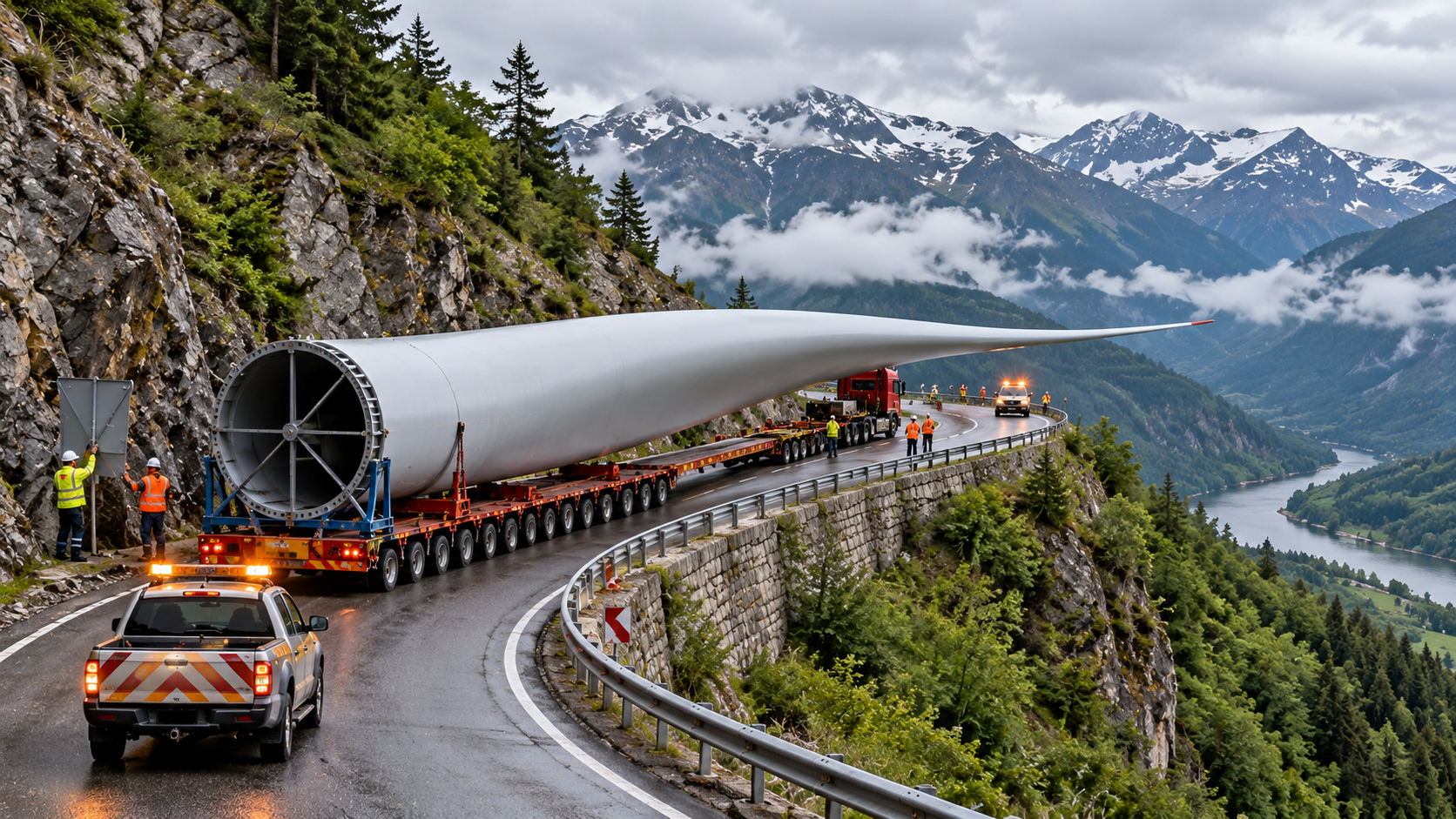
A modern wind turbine blade is 35 to 80 m long and weighs 15 to 26 t. It must be delivered in one piece, without being disassembled. Transportation speed is almost irrelevant here: the key is to find a vehicle physically capable of carrying such a load and a route along which the load can be transported.
Fewer transfers mean faster delivery
A conventional airfreight chain looks like this: factory — truck — airport warehouse — aircraft — destination airport warehouse — truck — recipient. This involves four transfer points and three modes of transport. Every transfer takes time, creates a risk of damage, and adds expense.
With “point-to-point” delivery, the chain is reduced to two points: loading at the sender’s site and unloading at the recipient’s site. Even if the vehicle itself travels more slowly, the total delivery time may be comparable or shorter because transfers and route preparation are eliminated.
What affects the efficiency of oversized cargo transportation?
- Load planning. Proper weight distribution on the platform determines stability and safety. An incorrect cargo configuration can increase fuel consumption by 15–20%.
- Equipment selection. Low-bed trailers, hydraulic platforms, and modular platforms are suited to different types of cargo. Matching the equipment precisely to the cargo reduces loading time and the number of empty runs.
- Route. For wide, tall, and heavy cargo, bridge load capacity, tunnel clearances, and road-surface condition all matter. A well-planned route can reduce travel time by up to 30% compared with one chosen in haste.
- Weather. Strong winds, rain, and snow restrict the movement of oversized cargo and cause schedule delays.
- Permits and documentation. Each jurisdiction has its own rules governing dimensions, weight, and movement procedures. Timely permits and routes agreed in advance prevent downtime.
Where payload capacity matters more than speed
| Cargo type | What matters most | Why speed is secondary |
|---|---|---|
| Transformers and generators | Payload capacity and axle loads | Route preparation takes longer than the journey itself |
| Wind turbine blades | Cargo length and route | The cargo cannot be disassembled; turning radii and bridges are the limiting factors |
| Drilling and mining equipment | Delivery to a remote site | There are no roads or airfields at the site |
| Industrial modules and steel structures | Dimensions and delivery in one piece | On-site assembly is more expensive and takes longer |
| Humanitarian supplies in emergencies | Access to a cut-off area | Ground infrastructure has been destroyed |
How cargo airships change the equation
Cargo airships are among the few modes of transport designed from the outset for heavy and large cargo with “point-to-point” delivery. Their strengths directly address the challenges of oversized cargo logistics:
- vertical takeoff and landing — no runway is required; a prepared site is enough;
- oversized cargo — an airship is large enough to carry loads that do not fit inside an aircraft, including on an external sling;
- delivery directly to the site — without transfers or the construction of temporary roads;
- low energy consumption per tonne of cargo — lift is provided by a gas that is lighter than air.

A cargo airship travels at about 100–130 km/h, which is slower than an aircraft. But for heavy cargo that would otherwise require weeks of route preparation, this difference is no longer decisive.
Payload capacity is a key parameter in the industry’s development. In France, Flying Whales is developing the LCA60T airship, designed to carry 60 t of cargo. In July 2026, India’s Bharat Forge and Flying Whales signed a memorandum at the Farnborough Airshow to develop and manufacture such airships in India, including for delivering oversized equipment to hard-to-reach areas.
New Generation Airships project: from experimental aircraft to production models
“New Generation Airships” is an AERONOVA project to develop, manufacture, and commercially operate innovative airships. The project is being developed with the help of SOLARGROUP, an international IT platform that facilitates investment.
The aircraft lineup is structured to increase payload capacity in stages:
| Aircraft | Purpose | Status |
|---|---|---|
| NOVA-01 | Unmanned experimental platform for validating key technical solutions | Testing |
| AEROLЁT-01 | Hybrid experimental aircraft | Restoration and design refinement based on test results |
| NOVA-2E | Unmanned electric cargo version, volume 2,000 m³, stated payload capacity 0.5 t | Being assembled; it will be the first to take to the air |
| NOVA-2 (crewed) | 1 pilot and 5 passengers, two ULPower helicopter engines | The engines have been purchased and delivered |
| NOVA-8 | The next production model for commercial cargo transportation and tourism, with a payload capacity of up to 3 t | Detailed design is under way; component and structural-frame production will begin no earlier than 2027 |
| NOVA-35 | The largest airship in the current lineup, with a payload capacity of at least 15 t | Included in the roadmap after serial production of the NOVA-8 |
What has already been achieved:
- the company launched in-house envelope production, and on August 19, 2026, completed the envelope for the full-size NOVA-2: volume 2,000 m³, length 43.2 m, and maximum diameter 9.6 m;
- on September 1, 2026, the envelope was filled with air for the first time, and the first cycle of strength testing was successfully completed; later, the envelope underwent an overpressure test, while the ballonet was checked for leaks;
- AERONOVA moved on to the final assembly of the NOVA-2.
This progression—from experimental platforms through an unmanned cargo version to the production NOVA-8 and NOVA-35—reflects the industry’s core principle: each successive aircraft increases payload capacity—from 0.5 t for the NOVA-2E to 3 t for the NOVA-8 and at least 15 t for the NOVA-35—and broadens the range of tasks it can perform.
On September 2, 2026, the New Generation Airships project moved to funding stage 4.
Frequently asked questions
How does heavy cargo differ from oversized cargo? Oversized cargo exceeds permitted dimensions, while heavy cargo exceeds permitted weight or axle-load limits. Cargo can be both heavy and oversized.
How is payload capacity calculated? Subtract the vehicle’s unladen weight from its maximum permitted gross weight. For example, a 40-foot container with a maximum gross weight of 30,480 kg and a tare weight of 3,700 kg has a payload capacity of about 26,780 kg.
Why is an aircraft not always suitable for heavy cargo? Large cargo may not fit in the hold, and there may be no airfield at the destination. Air transportation then also requires transfers and overland delivery, including route preparation.
Where is an airship more cost-effective than a truck? In places where a road must be specially prepared for heavy cargo or where no road exists at all: remote industrial, energy, and mining sites, as well as areas affected by natural disasters.
What payload capacities will the airships in the New Generation Airships project have? The unmanned electric cargo version NOVA-2E is designed to carry 0.5 t of cargo. The next production model, NOVA-8, is designed for loads of up to 3 t, while the largest airship in the lineup, NOVA-35, is designed for a payload of at least 15 t.
Conclusion
When transporting heavy and oversized cargo, vehicle speed is only one part of the equation. The decisive factors are payload capacity, dimensions, the ability to deliver the cargo in one piece and directly to the site, and the cost of route preparation. The fastest mode of transport is therefore by no means always the most cost-effective.
Cargo airships are being developed specifically for this niche. The New Generation Airships project by AERONOVA is expanding its capabilities in stages: in-house envelope production has been launched, final assembly of the NOVA-2 is under way, and the cargo NOVA-2E and production models NOVA-8 and NOVA-35 will follow.
This material is for informational purposes only and does not constitute individual investment advice. Crowdinvesting involves risk: the financial outcome depends on project implementation, the development of production, sales, and subsequent corporate transformation.
You can learn more about the New Generation Airships project and the current terms of participation in your account: SOLARGROUP — registration and project selection.