

How to Invest in International Startups and Technology Projects from South Africa: A Complete Guide for 2026

How to Invest in International Startups and Technology Projects from South Africa
Introduction
In 2025, South Africa recorded more venture capital deals than any other country in Africa—83 deals worth $524 million, accounting for about 90% of the total for the Southern Africa region. This is a domestic institutional venture capital market. But there is a separate, more straightforward question for private investors: can you invest your own money from South Africa in an international rather than local technology project—a startup, an engineering company or an equity crowdfunding project—and how can you do so without breaking any rules?
Source: AVCA, Venture Capital in Africa Annual Report, February 2026
Let us distinguish between two different issues from the outset. Buying foreign shares already traded on a stock exchange, such as Apple or Amazon, is a separate, well-documented subject, with access available through international brokerage apps such as EasyEquities Global. This article covers something else: privately held, pre-IPO technology businesses that have not yet gone public—startups, engineering projects and international equity crowdfunding.
The legal framework: SARB, SDA, FIA and AIT
The first and most practical question is not “which project should I choose?” but “how much money can I transfer abroad, and how?” This is governed by the South African Reserve Bank (SARB) through the exchange control system, which has the following thresholds in 2026.
Single Discretionary Allowance (SDA). From 2026, following an increase in the national budget, a South African resident aged 18 or over who holds a valid document may transfer up to R2 million abroad per calendar year without obtaining tax clearance from SARS. The previous limit was R1 million. A married couple may transfer up to R4 million in total if each spouse uses their own allowance.
Foreign Investment Allowance (FIA). In addition to the SDA, a resident may transfer up to R10 million per calendar year—up to R20 million per family—but this requires tax clearance from SARS in the form of Approval for International Transfer (AIT). The approval is valid for 12 months and, together with the SDA, provides a total annual allowance of up to R12 million per person.
Amounts above R12 million. These require a separate SARS document—a Letter of Compliance—which is then submitted to SARB for approval. There is no formal upper limit, but each application is considered individually.
In every case, any transfer must go through an authorised dealer—a bank—not directly or through informal channels.
Source: FinGlobal, “Your R2 million global opportunity,” April 2026; Sable International, South African Foreign Investment Allowance, 2026
Taxes. South African tax residents are taxed on their worldwide income. This includes both dividends and capital gains from international investments, regardless of where the platform or bank is physically located. This is a general principle, not individual advice: before transferring an amount that is significant to you, consult a tax adviser about the calculation method and rate applicable to your circumstances.
Equity crowdfunding in South Africa: what is still missing from the regulatory framework
A separate issue is the legal status of equity crowdfunding itself. South Africa currently has no regulations written specifically for this model; legal reviews describe the situation as a “regulatory vacuum.” Offering equity to a broad group of people may fall under section 95 of the Companies Act 2008 as an “offer of securities to any section of the public,” with disclosure requirements typical of a public company. Cross-border equity crowdfunding activity must also comply with the SARB exchange control rules described above.
Source: Dommisse Attorneys Inc., “The regulatory vacuum of equity crowdfunding in South Africa: time bomb or open door?”
The practical conclusion is that investors themselves are responsible for checking the status of a specific platform, whether South African or international. The country does not yet have a special fast-track regime or a dedicated local regulator specifically for equity crowdfunding.
Ways to invest in international technology projects
In practice, private investors from South Africa have five main options.
1. Angel syndicates. These bring investors together around a specific deal, usually within a particular sector. The minimum investment is typically $1,000, and proof of accredited investor status is often required.
2. General equity crowdfunding platforms. These allow investors to put a relatively small amount into a specific startup funding round, often without an accreditation requirement. Some platforms have a secondary market where investors can sell their stake before the company exits.
3. Accredited investor clubs. This format is for those prepared to verify their accredited investor status in exchange for access to a curated deal flow—often through an SPV rather than by investing directly in a company’s equity. One practical example that is also open to South African investors is OurCrowd, based in Israel, which reports a presence in 62 countries.
4. International venture capital funds and funds of funds. This is the most fully managed format: instead of choosing individual deals, the investor buys an interest in a professionally managed fund. It also typically has the highest minimum investment.
5. Project-specific equity crowdfunding platforms. A separate category consists of platforms that directly arrange collective financing for one or more specific engineering projects. Here, investors neither select individual deals nor buy a diversified portfolio. Instead, they acquire an investment stake in the platform itself, which acts as a co-founder of a specific project company. This provides a lower entry threshold but concentrates the risk in one or two projects. SOLARGROUP, discussed below, is an example of this model.
|
Method |
What you invest in |
Typical minimum investment |
Accreditation required |
Key feature |
|
Angel syndicates |
Stake in a single deal through an SPV |
From $1,000 |
Usually yes |
You must join a sector-specific syndicate |
|
General equity crowdfunding |
Equity stake / convertible note |
From $10–£10 |
Not always |
Some platforms have a secondary market |
|
Accredited investor clubs (e.g. OurCrowd) |
Interest in a fund/deal through an SPV |
From several thousand dollars |
Yes |
Professional deal selection |
|
International VC funds / funds of funds |
Interest in a fund (LP) |
From $50,000+ |
Generally yes |
Diversification, but a high entry threshold |
|
Project-specific platform |
An investment stake in the platform, later exchanged for shares in the project company |
From tens to hundreds of dollars |
Usually no |
Concentration in 1–2 projects |
Thresholds and requirements vary by platform, jurisdiction and funding round. The table shows typical orders of magnitude, not guaranteed terms. Regardless of the format, transferring money abroad from South Africa is subject to the same SDA/FIA/AIT rules described above.
How to check a platform before investing
- Legal registration and licence. In which jurisdiction is the operator registered, what is its registration number, what licence does it hold, and can these details be checked in a public register?
- Status in relation to the FSCA. Most international equity crowdfunding platforms are not regulated by South Africa’s FSCA. This is normal for an international service, but it means that all due diligence rests with the investor rather than the local regulator.
- Publicly available terms. Are the deal terms published openly: what exactly are you investing in, what fees apply, and how are the investor’s rights documented?
- Documents issued upon payment. Does the platform issue an agreement and a certificate for the stakes purchased as a standard part of the process, rather than only “on request”?
- Refund terms. Most venture capital and equity crowdfunding formats do not provide for the automatic return of money that has already been invested. This is a normal feature of the model, not a sign that a particular platform is acting in bad faith.
Key risks
- Venture risk. Most early-stage investments produce no return at all; the outcome is not guaranteed.
- Low liquidity. A stake in a private company usually cannot be sold quickly before the company goes public or is acquired.
- Currency risk. Returns in rand depend on the ZAR exchange rate against the platform’s currency at the time of entry and exit.
- Regulatory and jurisdictional risk. The rights of a foreign minority investor are protected by the laws of the country where the company or platform is registered, not by South African law.
- Platform risk. The reliability and integrity of the intermediary itself should be assessed separately from the prospects of a particular deal.
Step-by-step guide
- Set your budget within the SDA/FIA allowances: determine how much you are prepared to transfer abroad this calendar year, taking into account any portion of the allowance already used for other purposes.
- Choose a format—a syndicate, general equity crowdfunding, an accredited investor club, an international fund or a project-specific platform—based on your budget and willingness to accept concentrated or diversified risk.
- Check the platform and the deal against the checklist above.
- Register and, if the format requires it, complete verification (KYC). Some platforms, including project-specific platforms, allow a purchase without verification at this stage but require it later, for example when documenting rights to shares.
- Transfer funds through an authorised dealer—within the SDA without SARS approval, or under the FIA with an AIT in place.
- Sign the agreement and keep the documents—the agreement, proof of payment and the certificate for the stakes purchased.
- Declare income when it is actually received—dividends and capital gains—as part of your worldwide income for SARS purposes.
- Monitor progress and understand in advance how an exit could work—do not count on a quick or guaranteed return of capital.
A practical example: the SOLARGROUP platform
SOLARGROUP is an international equity crowdfunding platform that brings together investors, partners and technology projects. According to company data for 2025, its community included more than 583,000 members from 194 countries, including 86,400 investors and 23,100 active partners, while the total amount raised exceeded $120 million.
Its presence in South Africa is more than theoretical
The platform has an active community in South Africa. From June 19 to 23, 2025, SOLARGROUP held meetings in four cities: more than 400 guests in Durban, around 50 in Matatiele, 30 in East London and around 50 in Pretoria—more than 500 people in total. Participants came from South Africa, and some meetings also included guests from Zimbabwe and Lesotho.
At a SOLARGROUP conference in Johannesburg, Andrey Lobov, director of the Resource production cooperative, met Johannes de Vries, head of South Africa’s SolarChaser project.
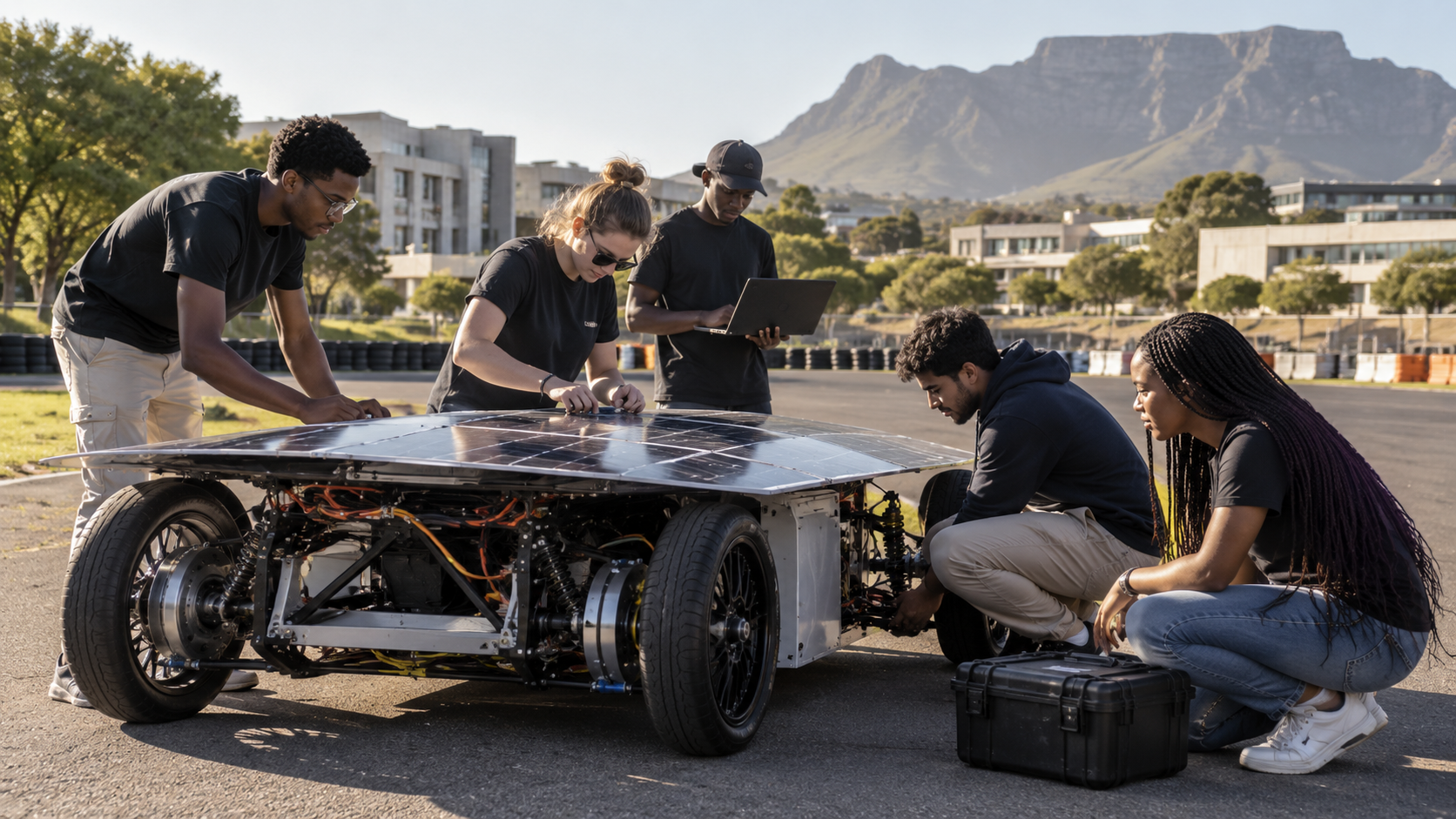
SolarChaser: the local technology context. SolarChaser is a project at Tshwane University of Technology in Pretoria. A team of more than 20 students is developing a solar car whose fourth version is due to compete in an international race across South Africa. The car has two rear BLDC hub motors with a maximum power consumption of 2 kW. When powered solely by its solar panels, without a battery, it is claimed to cover more than 400 km during daylight hours. This is not a SOLARGROUP project but an independent local initiative with which the platform has established direct contact.
On February 18, 2026, partners from South Africa personally visited the facilities of both platform projects—the Sovelmash D&E facility and AERONOVA’s office and airfield—and watched NOVA-01 fly.
Two projects available through the platform
Duyunov's Motors is based on the Slavyanka combined winding technology for electric motors used in electric transport, industry, agriculture and household applications. The project is being implemented by Sovelmash in the Technopolis Moscow Special Economic Zone. A cold heading machine is being delivered to the facility for the future production of Angle grinder shaft and axle blanks at a rate of up to 6 units per second; additional finishing will be required to achieve final precision. Commissioning of a nitrogen station has also been completed, with nitrogen purity of 99.98% and an outlet pressure of 10 atmospheres without a booster. Serial production of angle grinders and aircraft, built-in and housed motors with Slavyanka windings continued in August 2026. The shipment of the first batch of 12 different products to China was also confirmed.
New Generation Airships(AERONOVA) has progressed through several funding stages: it moved to Stage 2 on June 19, 2025, and as of September 9, 2026, the project is already at Stage 4. It raised $5 million at Stage 3, and the project fund has exceeded $15.5 million with support from more than 14,200 people worldwide; the funding target is $100 million. AERONOVA holds a licence from the Ministry of Industry and Trade to develop aeronautical equipment. The unmanned NOVA-01 and the hybrid AEROLЁT-01 have been assembled and are undergoing flight testing. Production of the NOVA-2 envelope was completed on August 19, 2026 (2,000 m³, 43.2 m long and 9.6 m in maximum diameter). The envelope was transported to Kirzhach, inflated with air and put through its first round of strength testing. On September 8, 2026, successful pressure testing and a leak-tightness check of the ballonnet were confirmed, with no unacceptable leaks or deviations detected. The envelope test programme is continuing. Two petrol-powered helicopter engines made by the Belgian company ULPower and a repair kit for one of them have already been purchased and delivered for the future passenger version of NOVA-2. At the same time, the unmanned, all-electric NOVA-2E cargo version is being assembled.
What has been confirmed and what remains a plan
It is important to distinguish fact from intention here.
✅ Confirmed: an active SOLARGROUP community in South Africa; meetings with more than 500 guests across four cities in June 2025; a visit by South African partners to the facilities of both projects in February 2026, where they watched NOVA-01 fly; serial production at Sovelmash and shipment of a batch to China; the New Generation Airships project reaching Stage 4 of funding; a completed NOVA-2 envelope tested for strength and leak-tightness; and NOVA-01 and AEROLЁT-01 assembled and flying in test mode.
⚠️ Not yet confirmed: a successful ballonnet check does not mean that the entire envelope test programme has been completed, that NOVA-2 has been assembled as a complete aircraft, or that its flight tests have begun. Getting the crewed version of NOVA-2 airborne “next summer” is a target stated by the team, not an achieved result. NOVA-8 is at an early design stage; production has not begun and is planned to start in 2027. The potential future production of five or six NOVA-2 aircraft is based on preliminary arrangements, not a confirmed order volume. Future dividends, the exchange of investment stakes for shares and asset appreciation depend on the projects being implemented and on subsequent corporate procedures; none of these outcomes is guaranteed.
Is participation available specifically from South Africa?
The platform’s official FAQ lists restrictions on direct participation in Duyunov's Motors for citizens of Japan, the United Kingdom, Australia, Canada and the United States. South Africa is not on this list, meaning that the available data indicate no formal restriction for South African citizens.
Participation is arranged through the personal account: register → open the “Investments” section and select a project → sign the agreement digitally → select and pay for an investment package → track investments and payments in the personal account. Identity verification is not required to purchase the package itself, but it will be required later when applying to receive shares. The available account funding methods are shown in the “Wallet” section under “Add Funds.” The data do not include a separate confirmed list specifically for South Africa, so current methods should be checked directly in the personal account rather than assumed in advance. Regardless of the method selected, transferring money abroad from South Africa remains subject to the SDA/FIA/AIT rules described at the beginning of this article; the platform does not handle this on the investor’s behalf.
What this means for readers in South Africa
The value of this combination lies not in bold promises, but in the fact that it can be verified on two levels at once. International access and a genuine connection to South Africa are supported by specific events, the community and personal visits by partners. The projects’ progress is supported by production at Sovelmash and by the manufacture and testing of the NOVA-2 envelope. At the same time, the investment outcome, the exact timing of NOVA-2 flights and future capitalisation remain future scenarios rather than accomplished facts. A clear-eyed article must say this directly instead of hiding it behind generalities.
Frequently asked questions
Is it legal for a South African resident to invest in an international startup or project?
Yes, within the SARB allowances: up to R2 million per year under the SDA without tax clearance, plus up to R10 million under the FIA with an AIT in place. Transfers must always go through an authorised dealer.
Do I need to be an accredited investor?
It depends on the format. Some equity crowdfunding platforms and project-specific platforms operate without a formal accreditation requirement; angel syndicates and professional investor clubs generally require proof of such status.
Does the FSCA regulate these international platforms?
Generally, no. This is normal for an international service, but it means that investors themselves are responsible for checking registration and licensing.
Can a South African citizen invest in SOLARGROUP projects?
The official restrictions list for Duyunov's Motors names Japan, the United Kingdom, Australia, Canada and the United States; South Africa is not on the list. Current terms and available payment methods should be checked in the personal account.
What stage has New Generation Airships reached?
As of September 9, 2026, it is at Stage 4. It raised $5 million at Stage 3, and the project’s total fund has exceeded $15.5 million with support from more than 14,200 people.
Is NOVA-2 already flying?
No. Its envelope has been manufactured and tested for strength and leak-tightness; assembly of the aircraft as a complete unit and flight testing are still ahead. Getting the crewed version airborne “next summer” is the team’s plan, not an achieved result.
Does SOLARGROUP have a genuine connection to South Africa, rather than just registration?
Yes: an active community, meetings in four cities in June 2025, contact with the local SolarChaser project at a SOLARGROUP conference in Johannesburg, and a personal visit by South African partners to both production facilities in February 2026.
Can I get my money back if I change my mind after paying?
As a rule, there is no automatic mechanism for an immediate refund. This is a typical feature of venture capital and equity crowdfunding formats in general, not a feature of one particular platform.
Conclusion
In 2026, South African residents can legally invest in international technology projects through the SARB allowances (SDA, FIA and AIT) and one of five investment formats: a syndicate, general equity crowdfunding, an accredited investor club, an international fund or a project-specific platform. No format eliminates the need for basic due diligence: checking the platform’s registration, the public deal terms, and exactly what you are acquiring and on what terms you can exit.
SOLARGROUP is a working example of this model with an established connection to South Africa: an active community, local meetings and personal visits by partners to both projects. But as with any venture investment, engineering progress is not the same as a completed commercial outcome. Certification, serial assembly of NOVA-2 and future capitalisation remain future scenarios, not facts today.
The easiest way to review the current status of both projects, the payment methods available in South Africa and the registration process is directly through the personal account: SOLARGROUP—registration and project selection.