

Airships in Ladakh and Northeast India: Can air logistics solve the challenge of reaching remote regions?

Airships in Ladakh and Northeast India: Can air logistics solve the challenge of reaching remote regions?
In a nutshell: In Ladakh and Northeast India, the main logistical challenge is not distance but terrain, weather, and the seasonal availability of roads. Cargo airships can deliver large loads directly to their destination without roads or airfields, which is why India is already considering them as a new solution for hard-to-reach areas.
Introduction
India is one of the world's largest and fastest-growing economies, but its logistical landscape is highly uneven. Alongside modern industrial corridors, there are regions where even basic supplies are extremely difficult to deliver. The most striking examples are high-altitude Ladakh in the north and the eight states of Northeast India.
For such regions, the question of how to deliver cargo is often more important than how much it costs. Let us examine why logistics are so difficult here, how freight is moved today, and what role airship delivery could play.
Why Ladakh is one of the most logistically challenging regions
Ladakh is a high-altitude region in the Himalayas. Its capital, Leh, is located about 3,500 m above sea level, and many settlements and facilities are even higher.
Key logistical constraints:
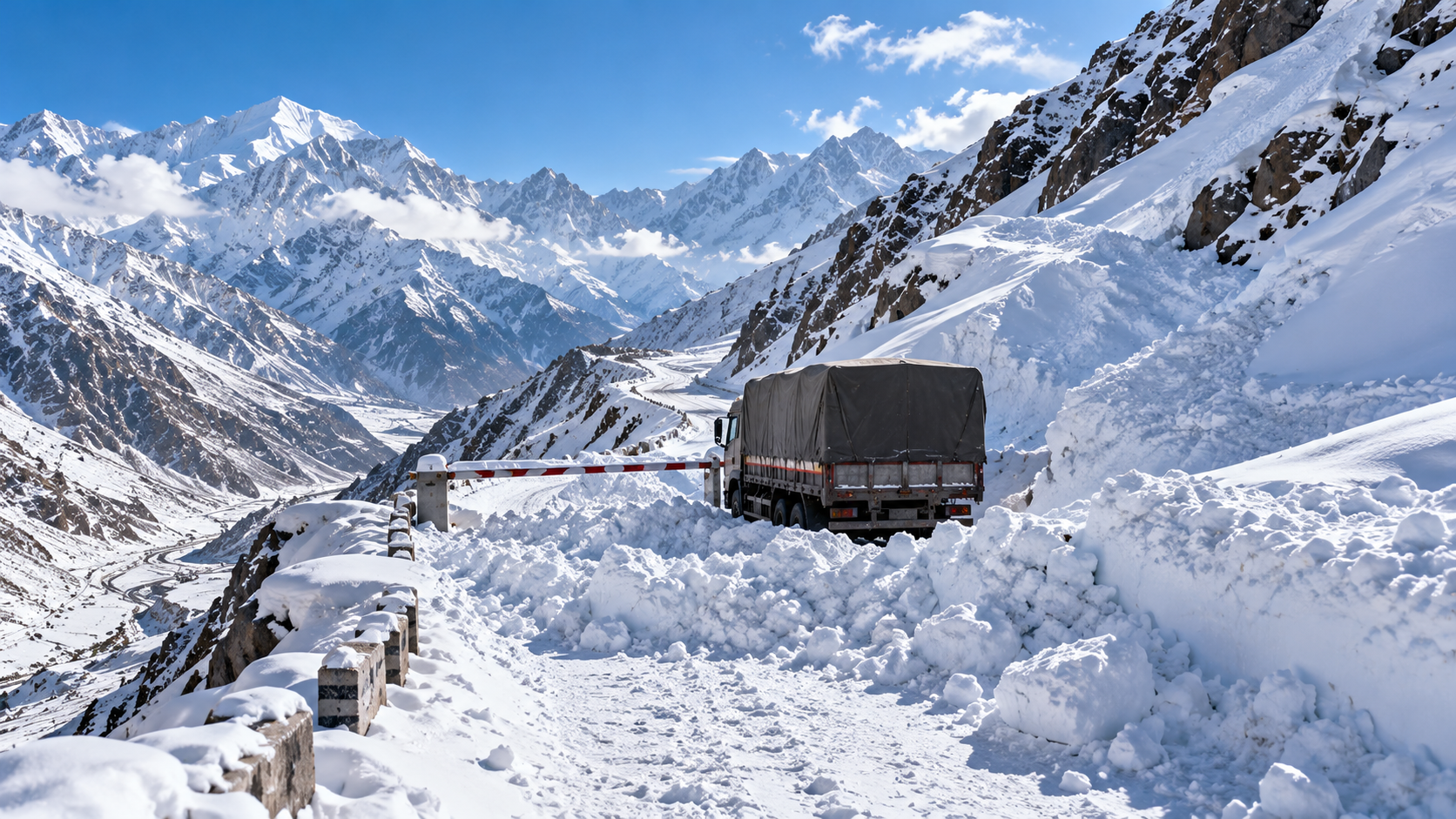
- Seasonal road access. Ladakh's main highways cross high-altitude passes that are closed by snow for several months in winter.
- Difficult terrain. Narrow mountain roads, switchbacks, elevation changes, landslides, and avalanches restrict the passage of heavy and oversized vehicles.
- Remoteness. Many settlements and facilities are located far from the main roads.
- Climate. Harsh winters and a short construction season narrow the window for freight deliveries.
As a result, much of the region's supply depends on air transport. One example illustrates its scale: in December 2018, the Indian Air Force airlifted a record 463 t of cargo to Ladakh in a single operation, using 16 transport aircraft in under six hours. The usual volume of air freight delivered to the region was about 3,000 t per month. But aircraft need airfields, and cargo must still be transported overland from the airfield.
Why Northeast India also remains hard to access
Northeast India consists of eight states connected to the rest of the country by the narrow Siliguri Corridor, which is about 20 km wide at its narrowest point.
The region's defining features include:
- mountains and dense forests — especially in Arunachal Pradesh, Nagaland, Mizoram, and Manipur;
- the monsoon season — heavy rains cause landslides and regularly wash out roads;
- major rivers — the Brahmaputra and its tributaries divide the territory and hinder overland travel;
- remote settlements — many communities are connected to the outside world by a single road.
Under these conditions, every major construction project—a hydroelectric power plant, bridge, or transmission line—becomes a logistical challenge: heavy equipment must be hauled along narrow mountain roads, and sometimes the road itself has to be built first.
How freight is delivered today
| Method | Strengths | Limitations in mountainous regions |
|---|---|---|
| Trucks | High capacity, low cost on good roads | Seasonal closures, landslides, restrictions on oversized loads |
| Cargo aircraft | High capacity, high speed | Airfields required, followed by ground delivery |
| Helicopters | Delivery to any location | Limited payload capacity, especially at altitude; high cost |
| Porters and pack animals | Access to the most remote locations | Very low capacity |
There is a clear gap between bulk transport, which requires infrastructure, and helicopters, which have limited payload capacity. Cargo airships could fill this gap.
What airships can offer remote regions
Delivery without roads or airfields
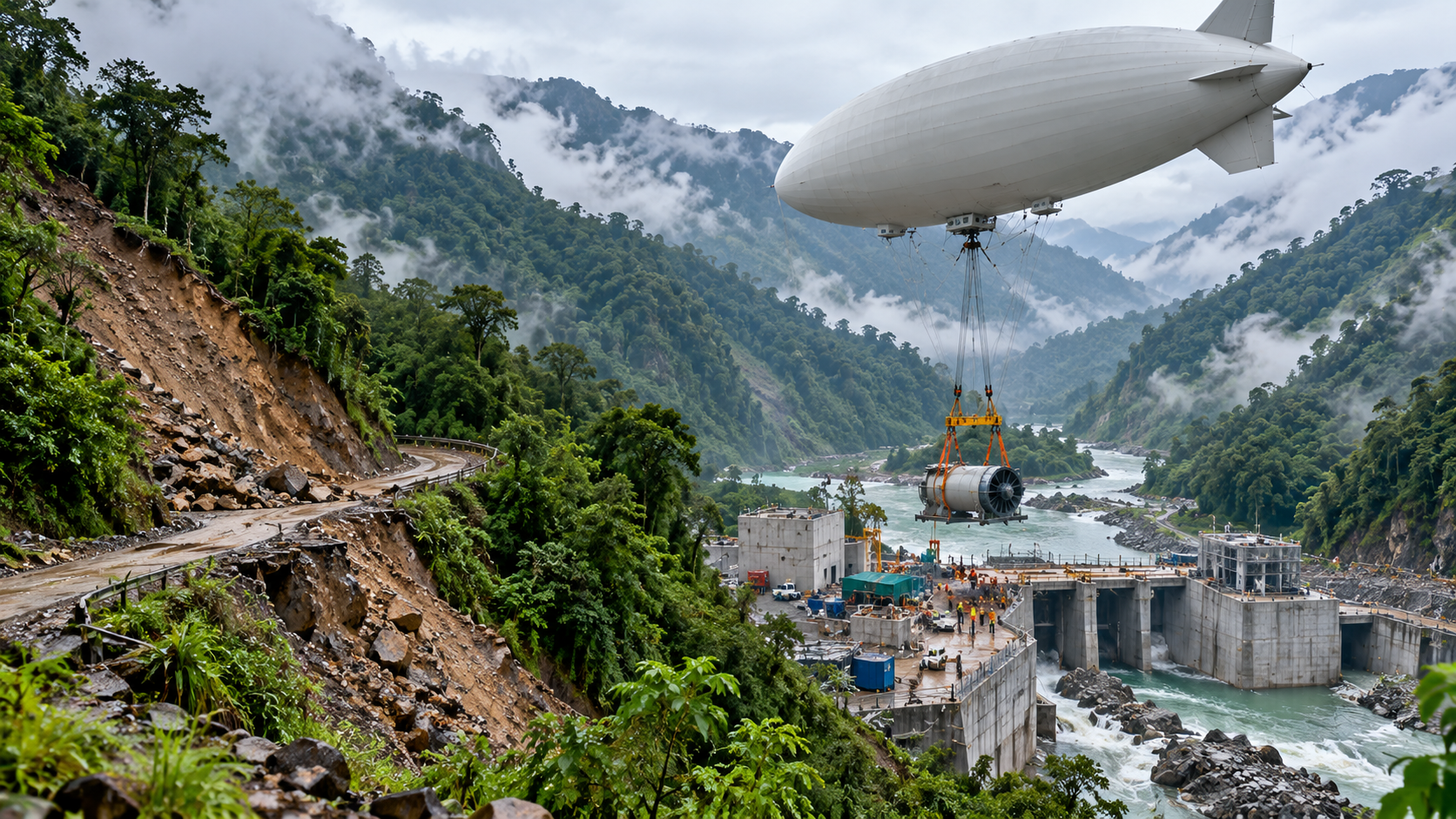
A cargo airship can take off and land vertically. It only needs a prepared site, and cargo can be lowered by cables directly to its destination. This is especially important in the mountains, where building roads and airfields is expensive and takes years.
Oversized and heavy cargo
Building hydroelectric power plants, solar power plants, bridges, and transmission lines requires the delivery of transformers, turbines, steel structures, and prefabricated construction modules. An airship can carry such cargo in one piece, without disassembly or route preparation.
Operations independent of seasonal road access
When mountain passes are closed by snow or roads are washed out by monsoon rains, ground delivery stops. Air transport that does not depend on roads makes it possible to supply the region for most of the year.
Disaster relief
Landslides, floods, and earthquakes can cut areas off from the rest of the country for days or weeks. An airship can deliver a large consignment of humanitarian supplies, medicines, and equipment and remain aloft over the disaster area for an extended period.
Monitoring and communications
The ability to remain aloft for long periods makes airships a useful platform for monitoring vast areas, forests, rivers, and infrastructure, as well as for relaying communications in the mountains.
Engineering considerations for mountain operations
High-altitude operations impose specific requirements on airships, which developers account for in their designs:
- Air density. At an altitude of 3,500 m, the air is about one-third less dense than at sea level, so the same volume of gas produces less lift. Operations at high altitude require adequate margins in envelope volume and payload capacity.
- Wind and weather. Mountain winds and rapidly changing weather require a precise control system, reliable mooring, and flight planning based on forecasts.
- Ground infrastructure. Even without an airfield, mooring masts, sites, and a maintenance system are required.
For such regions, large airships with ample payload capacity and modern automatic control systems are therefore particularly important.
India is already moving in this direction
In July 2026, Indian company Bharat Forge and French company Flying Whales signed a memorandum at the Farnborough International Airshow to jointly develop, manufacture, and operate heavy-lift cargo airships in India. The partnership centers on the LCA60T airship:
- payload capacity of up to 60 t;
- vertical takeoff and landing;
- minimal ground infrastructure requirements;
- hybrid-electric propulsion system.
Planned applications include supplying forward bases in hard-to-reach areas, transporting oversized equipment, surveillance and communications relay, rapid delivery to remote border regions, humanitarian aid, and disaster response. The partnership aims to establish a domestic airship manufacturing industry in India.
This step shows that cargo airships are becoming a practical tool for solving India's logistical challenges in difficult terrain.
Experience from other countries: northern logistics
Other countries with hard-to-reach territories face similar challenges. A University of Manitoba study in Canada on supplying isolated northern communities found that a cargo airship with a 50 t payload could generate annual transport cost savings of 12.5% to 38.3% compared with seasonal winter roads and air freight. Northern Canada's logistical challenges—seasonal road access, expensive air freight, and remote communities—largely mirror those of Ladakh and Northeast India.
Airship use cases in Ladakh and Northeast India
| Task | Why an airship is suitable |
|---|---|
| Supplying remote settlements in winter | Not affected by closed mountain passes |
| Construction of hydroelectric power plants, solar power plants, and transmission lines | Delivery of heavy equipment directly to the site |
| Construction of bridges and infrastructure | Transporting large structures without route preparation |
| Relief after landslides, floods, and earthquakes | Access to cut-off areas and high cargo capacity |
| Monitoring forests, rivers, and infrastructure | Long endurance |
| Tourism | New routes through mountainous and natural areas |
The New Generation Airships project
New Generation Airships is a project to develop, manufacture, and operate innovative airships, implemented by AERONOVA. The project is being developed with the support of SOLARGROUP, an international IT platform for facilitating investment.
Progress to date:
- experimental aircraft have been assembled and tested—the NOVA-01 unmanned platform and the hybrid AEROLЁT-01;
- the company launched in-house envelope production and completed the full-size NOVA-2 envelope on August 19, 2026: volume 2,000 m³, length 43.2 m, maximum diameter 9.6 m;
- on September 1, 2026, the envelope successfully completed its first cycle of strength tests, followed later by elevated-pressure testing, while the ballonet underwent a leak-tightness test;
- AERONOVA is preparing the NOVA-2 systems for transfer from the test stand to the full-size envelope and subsequent phased assembly.
The lineup is designed for a phased increase in payload capacity: the first to take flight will be the NOVA-2E unmanned electric cargo version, with a stated payload capacity of 0.5 t; the next production model will be the NOVA-8; and the project roadmap provides for a transition to serial production of the largest airship in the lineup, the NOVA-35.
Another area important for high-altitude and hard-to-reach regions is stratospheric technology. The team has tested controlled payload recovery technology: after completing its mission, a lightweight glider separates from the high-altitude balloon and returns the equipment to the launch area or a designated retrieval point.
The New Generation Airships project is currently at stage 4 of funding. You can invest in the project through your SOLARGROUP personal account; packages and their nominal values may change from one stage to the next, and current nominal values are shown on the purchase page. To learn more about how an investor from India can participate in international projects, see the article “How to Invest in International Technology Startups from India.”
Frequently asked questions
Why is it so difficult to deliver freight to Ladakh? The region lies high in the Himalayas, its main roads cross mountain passes that are closed by snow for several months in winter, and the mountainous terrain restricts the passage of heavy vehicles.
What are the logistical challenges in Northeast India? Mountains, dense forests, major rivers, and the monsoon season, when landslides wash out roads. In addition, the entire region is connected to the rest of India by the narrow Siliguri Corridor.
Can airships operate at high altitude? Yes, but the air is less dense at altitude, so the same volume of gas produces less lift. Mountain operations require airships with adequate margins in envelope volume and payload capacity, a precise control system, and reliable mooring.
Are there cargo airship projects in India? Yes. In July 2026, Bharat Forge and Flying Whales signed a memorandum to develop and manufacture LCA60T heavy-lift cargo airships with a payload capacity of up to 60 t in India.
What tasks can airships perform in India's hard-to-reach regions? Supplying remote communities, delivering heavy equipment for construction and energy projects, disaster relief, monitoring territories, and tourism.
How can an investor from India participate in the New Generation Airships project? You can invest in the project through your SOLARGROUP personal account. The project is at stage 4 of funding; current packages and nominal values are shown on the purchase page in your personal account.
Conclusion
In Ladakh and Northeast India, logistics are shaped by mountains, seasons, and weather rather than distance. Existing transport either depends on roads and airfields or has limited payload capacity. Cargo airships can fill this gap by delivering large and heavy loads directly to their destination, without building temporary infrastructure and regardless of seasonal road access. The partnership between Bharat Forge and Flying Whales shows that India is already taking this mode of transport seriously.
AERONOVA's New Generation Airships project is developing this field in stages: in-house envelope production has been launched, the NOVA-2 systems are being prepared for transfer to the full-size envelope, and the NOVA-2E cargo version and the NOVA-8 and NOVA-35 production models lie ahead.
This material is for informational purposes only and does not constitute personalized investment advice. Crowdinvesting involves risk: financial outcomes depend on project implementation, the development of manufacturing, sales, and the subsequent corporate transformation.
You can learn more about the New Generation Airships project and the current participation terms in your personal account: SOLARGROUP — registration and project selection.